Strong Brand Strong Business
How WHOOP set a new standard at the Tour de France: Storytelling and stats
WHOOP's data appeared inside the 2026 Tour de France broadcast, during the stages themselves. This is editorial integration in motion. Here's what any brand can learn from the strategy.
Key takeaways
WHOOP was the presenting partner for Warner Bros. Discovery's global broadcast coverage of the Tour de France, and the official wearable for UAE Team Emirates - the team of five-time winner Tadej Pogačar.
Rider biometric data - HRV, recovery scores, sleep quality, strain - appeared on screen during race coverage, woven into commentary, rather than purely being confined to ad breaks.
WHOOP reported $1.1 billion in annualised bookings in 2025, up 103% year on year, with 2.5 million members and record low churn - more than 50% of members still use the product daily after 18 months.
The strategic logic of WHOOP’s approach to its Tour de France play is a useful reference for brand-less businesses looking to build credibility in a performance category.
Along with millions of other people, I spent the past few weeks watching the Tour de France on TNT Sports. WHOOP’s marketing strategy was loud and clear from the moment the coverage started in Barcelona on the 4th of July.
WHOOP's rider data was being shared on screen. Nothing new there - everyone knows that the Tour is a prime advertising opportunity. But WHOOP wasn’t just popping up during commercial breaks.
We were seeing rider data during the stages themselves. Recovery scores, heart rate variability, sleep quality, and data on the fitness of Pogačar, van der Poel, and Philipsen going into the race. All being threaded into the commentary while we were all emotionally absorbed in watching the best cyclists in the world compete.
It was clear that while riders would be spending the next three weeks earning points and winning jerseys, WHOOP would be focused on earning credibility and gaining trust.
The thing is, you don’t need a big budget - or a Tour de France level opportunity - to apply the same strategy to your own business.
You just need to understand what WHOOP did and why. This is useful for any brand-led business trying to stand out in a crowded market.
Was this just sponsorship - or something else?
Sponsorship puts your name on something. This might be a finish line banner, or a jersey sleeve. It’s where the brand is present but the product isn't, so the association is visual, rather than functional.
The next level up is product placement. This is where the product appears in the content itself. Everyone remembers Friends for this - casually referenced Pottery Barn, Coca-Cola, Ben & Jerry’s… and many more.
The distinction between product placement and standard sponsorship is that the brand is in the scene rather than beside it. But the product is still passive. Remove the branded can and the scene still works.
The point here is that normal sponsorship - be it branding or product placement - the content doesn't need the brand to function.
What WHOOP did at the Tour was different. It used editorial integration.
What is editorial integration? What value does it create?
As presenting partner for Warner Bros. Discovery's global coverage, WHOOP's rider biometric data appeared within the editorial fabric of the race itself.
When a commentator referenced Pogačar's recovery score, van der Poel's HRV, or Carapaz's strain going into the final stage - they weren't doing a hard sell. They weren’t even doing a soft sell. They weren’t “selling” at all - at least, not in an overt way. Commentators were simply describing what WHOOP measures.
The product was demonstrating its value in one of the most demanding competitive contexts in the world, to an audience entirely focused on performance. And this was compounded across its own social channels too.
Everything was perfectly aligned with WHOOP’s founding focus on giving performance-oriented insights into their physical condition - making it possible to understand and manage the previously unknown inputs that affected their outputs.
This wasn’t usual product placement because if we’d removed WHOOP's data from that commentary, we wouldn’t have just lost the brand - we’d have lost the content, and the depth of the narrative.
The HRV score was part of the story. The recovery data helped explain why a rider couldn’t catch the breakaway. That's a categorically different commercial relationship between brand and broadcast.
It’s also why WHOOP’s editorial integration is worth understanding within the content of a brand-led marketing strategy, distinct from sponsorship or product placement.
Why is it worth learning from WHOOP’s marketing strategy?
Before we blindly follow WHOOP as an example of “best practice” for its marketing efforts, you’ll need some evidence that it knows what it’s doing. Especially given it’s notoriously difficult to draw a direct line between brand building and the P&L, so we have to look at correlation instead.
And looking at WHOOP’s performance to date, we can have confidence that at a headline marketing strategy level, the sum of WHOOP’s efforts - compounding indirect and direct impact - is having a clear commercial impact.
In 2025, WHOOP reported more than 2.5 million members, saying it was cash flow positive with subscriptions and bookings both increasing 103% during the same period. The business was operating a $1.1 billion (£830 million) revenue run rate with record low churn for the category - more than 50% of members were still using the app daily after 18 months. By March 2026, WHOOP had closed a $575 million Series G round (£432.5 million) which valued the company at $10.1 billion (£7.6 billion).
The retention metric is key here, as that’s the engine of the business’ value. Consider billing 2.5 million people for 18 months one of the following packages:
WHOOP One at £169 per year
WHOOP Peak at £229
WHOOP Life at £349
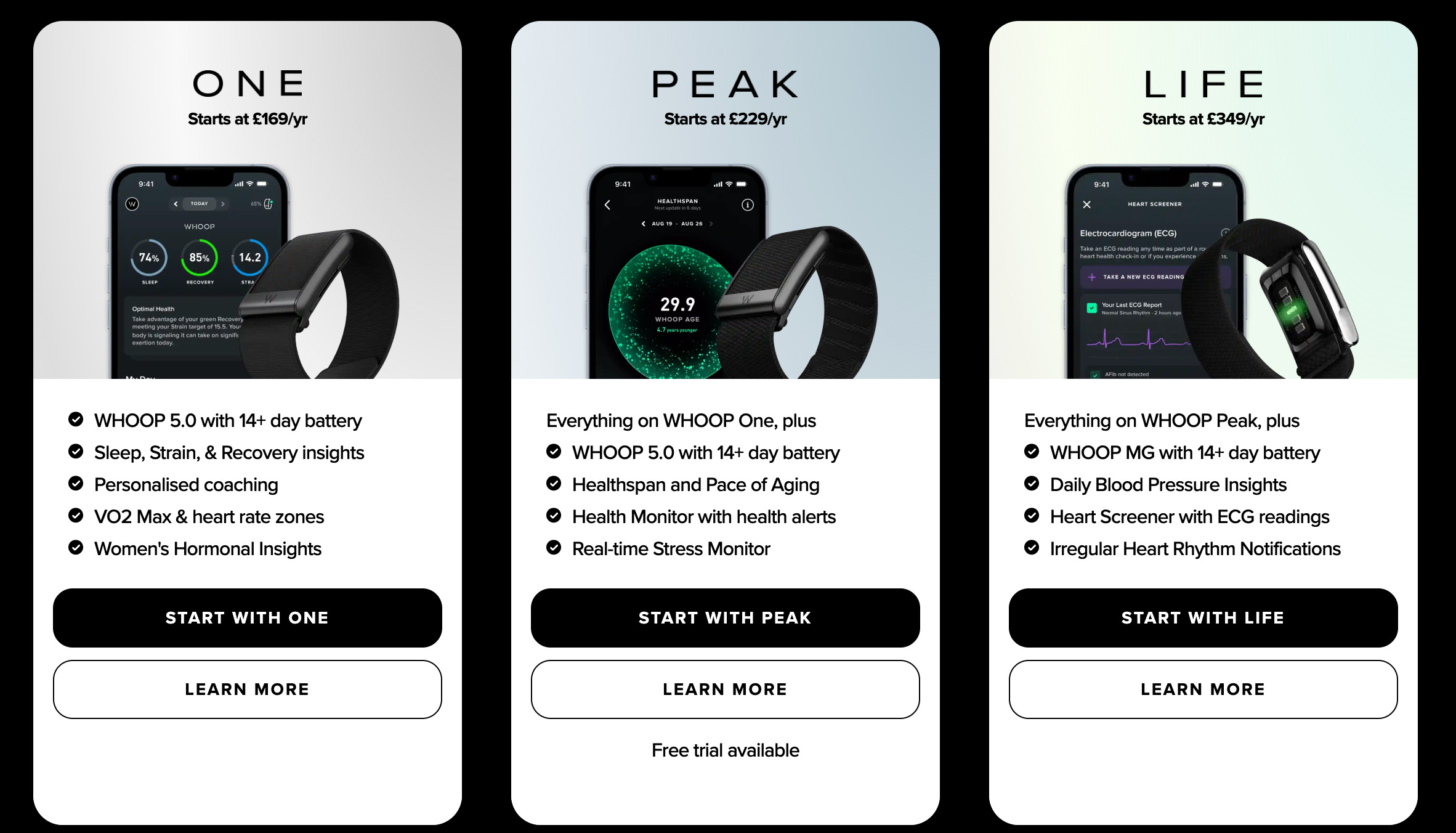
The capital engine behind the business is its subscriptions. WHOOP is not valued as a wearable - it’s valued as a premium subscription product. An important distinction when understanding its valuation in a crowded wearables market.
The commercial challenge that WHOOP has now - when looking to grow and increase its customer base - isn't convincing existing performance athletes to buy. It's maintaining the credibility that justifies the price point as the category broadens and competition increases. The Tour de France is doing the leg work on both fronts.
How does editorial integration help credibility in ways that normal advertising can't?
When someone’s watching an ad break, they’re in a transactional state. They know that they're being sold to, so there’s already an element of, “How much am I going to believe what I’m being told?”
However, when someone’s watching editorial integration, they’re in an absorptive state. They're watching a race, emotionally invested, and they’re not making any decisions. The brand association forms without the friction of being pitched.
How did WHOOP turn the Tour into a content engine?
One of the more interesting things WHOOP did around the Tour was publish comparative data: their riders' biometric profiles against more than 15,000 active members. Van der Poel's HRV at 143ms against a 71ms average for age-matched cyclists. Pogačar's 578 hours on the bike in the lead-up to the race.
This isn't manufactured broadcast content - it's owned content and proves what the product captures. Even better, its content that’s being generated as the race unfolds. For a subscription product whose value is in the data it generates over time, that's a meaningful commercial asset.
The additional benefit for WHOOP - specifically within the context of the Tour de France - is that the viewer is already in the world of performance sport. They understand recovery, training load, and physiological data. WHOOP doesn't have to spend time educating them, so it can get straight to the metrics. This is an important part of protecting its performance focus as it scales into different consumer groups.
Editorial integration at the highest level of sport maintains the association with elite performance even as the product becomes more accessible. It's a mechanism that standard advertising, on its own, can't replicate.
What can any brand take from this?
The main lesson from WHOOP’s Tour de France play isn’t to 10X your marketing budget and form a presenting partnership with an international platform - it’s to work out when your product generates its greatest evidence of its value to customers. WHOOP's most effective content was the data on screen - the product demonstrating its value in a context that cyclists can only ever dream about.
The equivalent question for any brand is, where can your product show what it does, rather than tell people what it does? And how do you become an integral part of the story, rather than decoration?
FAQ
What was WHOOP's role at the Tour de France?
WHOOP was the presenting partner for Warner Bros. Discovery's global broadcast coverage of the Tour de France, and the official wearable for UAE Team Emirates. It shared rider biometric data as part of race coverage, instead of confining its partnership to advertising breaks.
What is editorial brand integration?
A form of brand presence where the product or its outputs are woven into editorial content rather than appearing in dedicated advertising space. The brand becomes part of the story itself. For WHOOP, that meant threading rider data into the commentary of the race.
Can any brand do this?
The mechanism is available to more brands than typically use it. The principle - find the context where your audience is already absorbed and find a way to evidence how your product can enrich their experience - applies across categories and budget levels. Sampling at events, content partnerships, community integration are all expressions of the same logic at different scales.
This content is produced for informational purposes. It does not constitute specific business, commercial, or investment advice for any individual organisation.