Strong Brand Strong Business
The 2027 Tour de France Grand Départ: Three Nations, One Opportunity
The 2027 Tour de France Grand Départ isn’t just about yellow jerseys. For UK cycling brands, it’s a rare chance to own both the invisible and human-led commerce of the sport.
The 2027 Tour de France Grand Départ - spanning Scotland, Wales and England - is being labelled as a “three-nation innovation”. And it is, for more reasons than just the route.
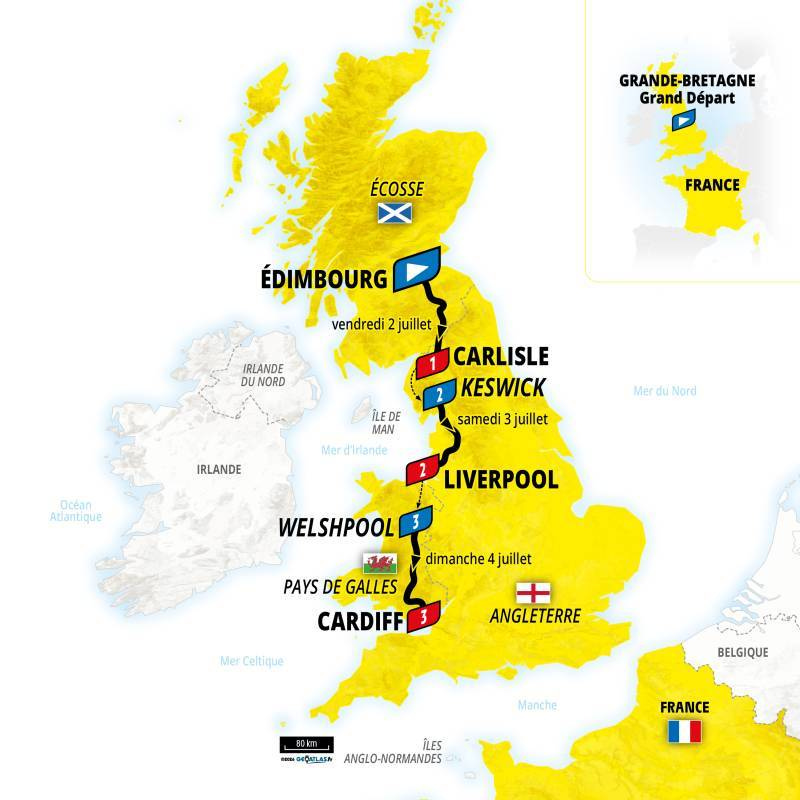
The 114th edition of cycling’s most famous Grand Tour is also a once‑in‑a‑decade commercial opportunity for UK cycling brands.
The next 18 months will separate those who take a strategic approach to winning, from those who think they can freewheel their way through one of the industry’s hardest commercial races.
This is especially true when eCommerce is already going through a period of significant change. UK cycling brands that align infrastructure, community relationships, and AI-ready product data now will dominate in 2027.
I’m speaking to a select group of UK cycling brands about readiness - DM me if you want to explore how to move before the window closes.
Why This Matters
Look back to 2007, when the UK Grand Départ took place in London and Kent. Transport for London reported that approx. 2.85 million spectators attended the various events.
(We since had one in Yorkshire, 2014 - but the majority of information is focused on 2007. Hence that’s the key reference here.)
Eyeballs alone don’t equal revenue. But the spike in visibility translated into tens of millions of pounds in direct local spending. Cycling participation also rose sharply: daily cycling journeys on major roads increased by 10.5% in the six months following the race - roughly 48,000 more rides per day.
This matters because of the commercial upside. More active cyclists = higher demand for low-frequency purchases (frames, wheels, helmets, saddlebags) and high-volume consumables (jerseys, bibs, inner tubes, cleaning products). The differentiator in which brand captures these sales is… visibility.
Invisible vs. Visible Economy
Invisible Economy
More and more consumers are using AI to do the heavy lifting - recommending, comparing, and even completing purchases before a customer types a thing. Around 50% of consumers now actively use search engines with AI recommendations or summaries. By 2027, agentic commerce could roll out globally, making AI-readiness critical for discovery.
Visceral Economy
People still value tactile, human-centred experiences: workshops, community rides, demos, expert consultations. Cycling is especially strong here: Strava reports it was the third-most logged activity for 2025, with cycling clubs increasing 2.8x.
The brands that master both economies simultaneously scale discovery, acquisition, retention, and advocacy - without eroding margin by paying for visibility.
Google is the Discovery Engine You Can’t Ignore
Winning isn’t just about great products or a Shopify listing. ChatGPT, Amazon, and social channels matter, but Google sits at the centre of discovery.
Its suite - Search, Maps, Shopping, YouTube, Business listings, Travel - forms a massive online surface. Data fed here powers its AI layer, including Gemini. Structured product data, local relevance, and EEAT signals (Expertise, Authority, Trust) shape what users see - both algorithmically and human-led.
These interfaces increasingly prioritise structured product data, local relevance, and signals of Expertise, Authority, and Trust (EEAT), shaping both algorithmic and human-led discovery.
Invisible economy
Precise metadata - specs, compatibility, inventory, delivery - lets AI know who your product is for, when, and why it matters. Gemini and AI Mode can surface products before anyone searches.
Visceral economy
Reviews, club partnerships, event participation, and business listings signal trust and authority. These human-led cues boost Maps and Search visibility, especially for regionally relevant queries during the Grand Départ.
If you get Google right now, and you compound visibility across both AI-driven and human touchpoints, it’ll be hard for competitors to catch up.
How to Win: EEAT + Local Relevance
Google’s recommendations are hyper-local. This means that what a rider in Cumbria sees differs from Edinburgh or Cardiff.
To win here, you need to focus on:
Community conversations: Reviews, social shares, collaborations feed EEAT.
Product intelligence: Structured metadata, SKUs, inventory, compatibility flags.
Localised presence: Clubs, cafés, hubs boost discoverability on Search and Maps.
National advertising alone won’t cut it. Human-led engagement combined with structured product data ensures visibility in the moments that matter.
Shopify-hosted brands have an edge: the Shopify x Google agentic commerce ecosystem is coming to the UK, and Shopify’s Standard Product Taxonomy gives you a proven framework for structured product data. (I wrote an article about it).
Who This Matters For
Established brands with deep regional heritage - especially those already operating on modern commerce infrastructure - may find this moment particularly important, creating a chance to reverse pressure after several challenging years.
Tailwinds for UK brands:
Shopify-hosted: AI partnerships with Google (who then did a deal with Apple - getting access to a prime ABC1 user base) help surface products in LLM-driven discovery and agentic commerce.
UK-based DTC: Faster shipping, lower customs friction, higher net margins turn operational advantages into both topline and bottom-line wins.
You have the tech. The differentiator now is how you execute - and when.
What I’m Already Seeing
Across UK cycling brands, there’s a pattern: strong products, capable Shopify infrastructure, genuine community intent - but no unifying strategy connecting AI discovery, local relevance, and commercial margin.
Most brands do parts of this work, but few treat it as a layered, coordinated system. Almost none align it to a fixed moment like 2027.
It’s not about being everywhere. It’s about being intentional, deep, and coordinated where it counts. Brands that align all three now will dominate invisible and human-led commerce next year.-led commerce next year.
Why UK Brands Can Move Faster
The UK cycling ecosystem is unusually tight-knit. Platform specialists, media partners, community operators, and brands are often just one or two conversations apart. Activate that network strategically - without diluting brand value - and you have a genuine advantage.
Markets like this reward holistic brands, not those chasing vanity metrics. Combine Shopify infrastructure, a strong network, and deep community expertise - and you can aim for first-mover advantage. The challenge is execution - without losing sight of today’s trading.
The Time to Act
You don’t need to do everything at once - but you do need to start.
Now (Q1-Q2 2026): Audit product metadata; map communities and clubs; secure early partnerships.
Q3-Q4 2026: Launch blended AI and community campaigns. Demo kits, curated rides, pop-ups.
Q1 2027: Test full activation - offline experiences aligned with A2A commerce-ready product lines, multi-region coordination, gather reviews and UGC.
Q2-Q3 2027: Full activation - refined offline experiences, multi-region campaigns, keep UGC fresh and relevant.
If you wait, you’ll be playing catch-up. Though the gap to the breakaway will be hard to close - the invisible shelf will already be stocked, and community credibility will already be locked-in.
Bottom Line
The 2027 Grand Départ is a rare moment: three regions, high-value ABC1 cyclists, and a market that rewards both automation and human-led experiences.
If you’re Shopify-hosted, UK-based, and thinking multi-layered, multi-region, you have more than an advantage - you have a tailwind.
The question now is about whether you’re going to invest strategically to get ahead.
If You’re a UK Cycling Brand…
Start with clarity, not a campaign:
Which products should be invisible, automated, AI-ready?
Which deserve human-led, community-driven premium positioning?
Where will local relevance matter most ahead of 2027?
I’m speaking with a small number of UK cycling brands about readiness - not selling software, but giving fixed-term GTM and eCommerce leadership before the window narrows.
Strategic clarity now will give you first-mover advantage. Wait too long, and you’ll be out of the race…
Note: This analysis draws on 2007 UK Grand Départ data, emerging trends in AI-powered commerce, and 16+ years of cycling eCommerce experience. Regional applications and community strategy reflect current UK cycling culture and infrastructure.