Strong Brand Strong Business
Unlock the High: What the Satisfy x adidas collab is actually about
“Unlock the High” is Satisfy’s tagline. For a growing, ambitious business, its collab with adidas runs deeper than brand awareness.
At a glance
83% of trail runners also run road. Satisfy pro Max Jolliffe is described as moving between “ocean, road, and alpine terrain with the same total commitment.” Its community runs both surfaces but, until last month, it didn’t make a road racing shoe.
Satisfy doubled revenue in 2024 to €11 million, and raised €11 million in a Series B in the same year. The brand set a revenue ambition of €100 million within five years.
Pre-funding, Satisfy’s own financial filings showed a €620,000 loss in 2022, with debt reaching €4.3 million and cash reserves falling to €305,000 by February 2024.
The Adizero Adios Pro 4 is adidas’ elite marathon racing shoe, built for fast efforts from 5K to marathon. Given Satisfy is a long-distance brand, the collab is coherent at a product level - even if there’s a cultural tension.
Satisfy already had TheROCKER, launched in 2025. It’s a mixed-terrain shoe capable from concrete to mud, not it a dedicated road racer. The adidas collab fills that specific gap.
On Running calls its own evolution becoming “a true toe-to-head brand.” In 2025, apparel revenues were up 68.2% while shoes increased by 27.5%. Apparel outpacing footwear at this rate suggests the uplift was driven by the existing running community extending its relationship with the brand, rather than a new audience arriving solely for the clothing.
31.5% of trail runners earn over $100,000 annually. While absolutes vary by survey, the trend is that trail runners’ incomes skew up and to the right. Satisfy is premium-priced, so there’s a logical sequence in deepening share of wallet first, then letting new customer growth compound on top.
Specialist challenger brands gained three percentage points of market share from Nike and adidas between 2019 and 2024. There’s market-wide confidence that serving specific customers, more completely, pays off.
In May 2026, Satisfy and adidas announced a multi-season collaboration. They launched their first product - a co-designed version of the Adizero Adios Pro 4 - at an event in the Arizona desert.
The most prominent commentary wasn’t favourable. The collab and its launch were described by one article as a “subculture heist.” The gist of the discontent was that something manufactured had replaced something earned. The Arizona event - a skate park, parkour, a gong, and paid fashion creators - felt like evidence of exactly that. Across social platforms, there was a read that said it was a commercially-driven abandonment of Satisfy’s usual raw, relatable, organic content, and a rebuff of the community’s own run clubs as the natural storytellers.
This can’t have been unexpected. adidas is one of the two largest sportswear companies in the world - the kind of brand that almost strengthens Satisfy’s community by giving them something to define themselves against.
This article isn’t going to weigh in on whether the collab is culturally right or wrong. It’s going to offer the commercial explanation for why it happened - and whether it actually reinforces Satisfy’s brand, or not.
Three questions:
Why would a brand built on rejecting mainstream running culture partner with one of the two biggest players in it?
Does the collab compromise what made Satisfy worth following?
If the community’s read was that it’s a cultural threat, what’s the commercial opportunity - and is it strong enough to carry the collab forward?
For the sake of length, the collab is only considered from Satisfy’s perspective - not adidas’, although there is strong rationale from their side too.
The Founder’s vision
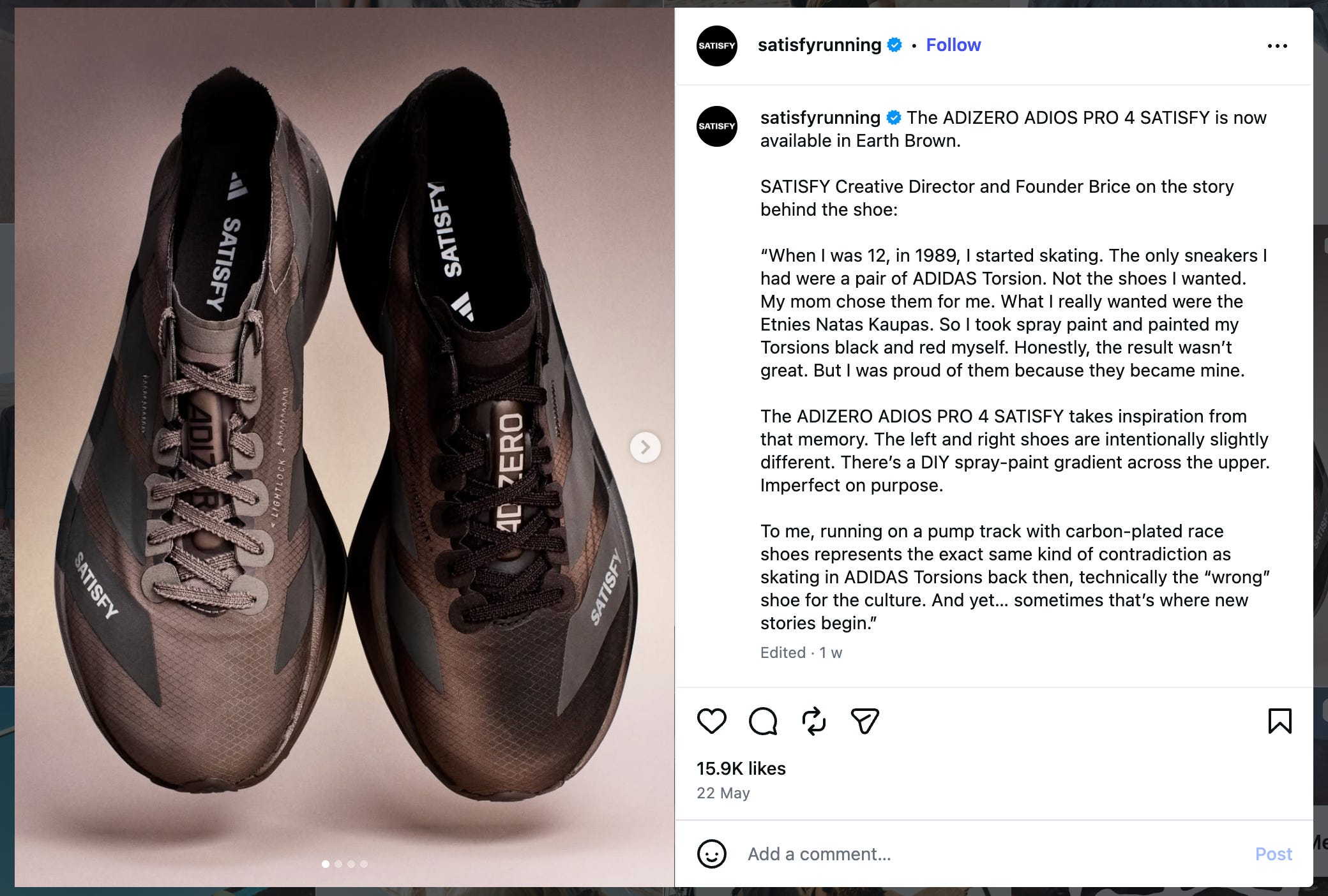
Brice Partouche, Satisfy’s Creative Director and Founder, framed the partnership on Instagram. He compared it to a 90s punk band signing to a major label - bringing a niche, disruptive identity to a larger stage without sacrificing it. It’s a fair analogy, though it only works if the label doesn’t start writing the songs.
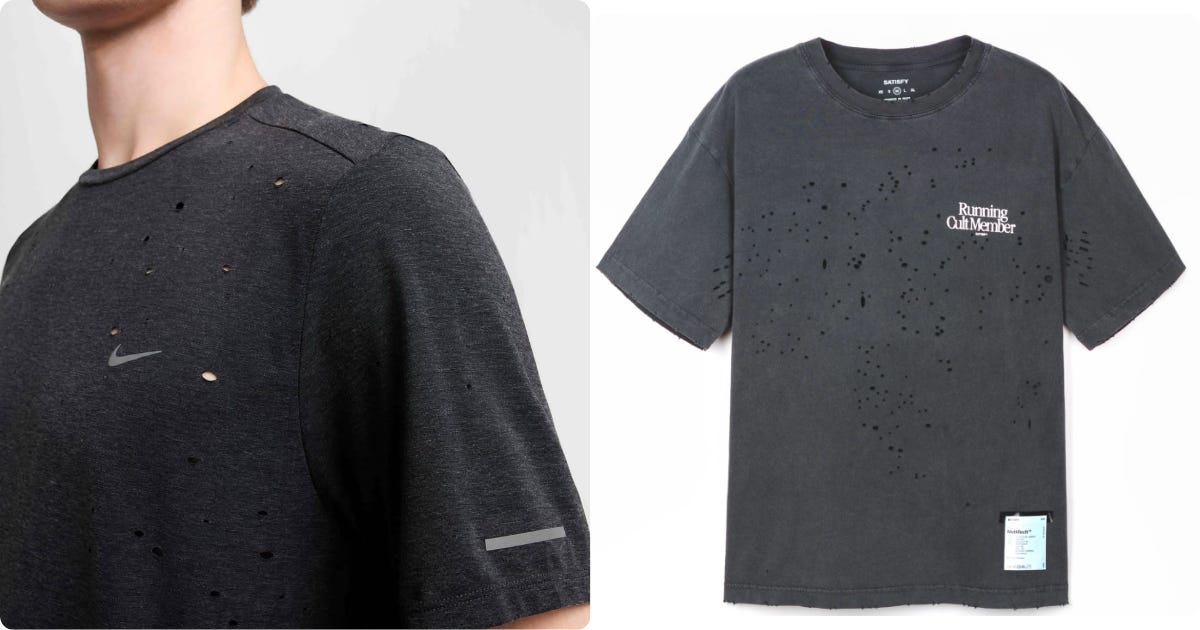
The second question - does it compromise Satisfy? - is what the community was really debating. Many questioned it, but some did lean in. On the announcement posts, there were comments asked for a matching version of the brand’s MothTech T-Shirt - people already extending the relationship into more categories before the shoe had shipped. The discontent was real, but so was the curiosity - and the demand.
The third question is the one that this piece is really here to answer. To be fair, it does consider the two previous questions - about adidas as the partner, and the identity compromise - but I’ll be working with commercial calculations rather than cultural opinion.
The overall verdict: the collab takes Satisfy closer to its community, not further away.
Why Satisfy needed adidas specifically
Satisfy’s commercial rationale for the collab starts with it choosing adidas as its partner. Earlier in 2025, Satisfy publicly called out Nike for taking a little too much inspiration from the MothTech aesthetic. Choosing adidas twelve months later is a statement about trust.
Then there’s commercial rationale for the product being a road shoe. The community runs both road and trail, and is largely performance-oriented (more on this - including evidence for the assertion - later).
While Satisfy’s existing shoe, TheROCKER, handles the long mixed-surface effort, a dedicated road racer is a different beast entirely. In 2026, a performance-oriented runner is looking for a shoe that’s carbon-plated, marathon-tuned, and optimised for pace on tarmac.
The Adios Pro 4 fills the gap. Its sibling broke three world records at the 2026 London Marathon - Sabastian Sawe ran 1:59:30, the first officially sanctioned sub-two-hour marathon. Getting to that race-day credibility independently would take a long time, and require a capital base that Satisfy doesn’t have.
The final consideration for why Satisfy chose adidas centres on it wanting to protect its distinct identity - even though that statement seems at odds with the community discontent.
adidas is known for supporting co-design - think Wales Bonner, Stella McCartney, and even Yeezy (whatever its politics, the products were distinct). Brice made sure that the collab didn’t stifle Satisfy’s quirk - the left and right shoes don’t match, there’s a DIY spray-paint gradient, and the launch comms wrapped a €300 (£250) race tool in a skate culture reference. The product is intentionally the wrong shoe for the culture - that’s pure Satisfy DNA.
Does the partnership compromise the community?
The counterargument can't be ignored - that the partnership might compromise the community regardless of the logical explanations. However, the drop sequencing did prioritise Satisfy’s DTC first - even before adidas customers. They launched on Satisfyrunning.com first, then adidas’s members-only platform, then adidas.com.
Beyond that, collab customers are routed away from Satisfy’s normal experience. The returns on the adidas collab shoe carry a handling fee that’s not applied to Satisfy’s own range. The logistics are being managed separately - with its own commercial terms.

Building the basket before the audience
Satisfy’s community is loyal, clear on what they stand for, and willing to pay a premium to express that. The risk is that mass distribution introduces a new kind of customer - one that doesn’t align with the identity that makes existing ones stay.
But Satisfy’s major challenge is that it needs to increase revenue, and it needs to do it capital-efficiently. Its numbers suggest growth has not been built on a sustainable base. The brand reported a €620,000 loss in 2022, with debt reaching €4.3 million and cash reserves falling to €305,000 by February 2024. In 2024 it doubled revenue to €11 million and accepted €11 million in investment, setting a five-year target of €100 million.
Where it has a deliberately constrained community and a 10X revenue ambition, the most capital-efficient way to achieve its target without burning VC capital, is to generate more from the customers it already has. It’s how profits can compound through increased customer spend - without incurring the relatively higher costs of acquisition marketing. From an investment return perspective, this is when growth becomes scale.
Capital-efficient growth in practice
I know that building the basket before the audience works because I’ve done it. As a marketer obsessed with brand, product, and numbers, partnered with an equally obsessed buying team, we grew a running category 22% year-on-year, across successive years - without depending on new customers. We did it by thinking left and right of the runner we already had.
We considered how their interaction with the sport spanned intervals, tempo runs, and long runs. How they had different shoes for different sessions, and different conditions. We thought about their sock rotation, the fact they might need a phone pouch for weekday miles, and a hydration pack for the weekend long run.
The alignment with Satisfy is that I did this within a retailer. We were also treating brands as collab partners who could help us to deepen our proposition. The commercial benefit was only realised because the actual focus was on serving the runner as holistically as possible.
The question was never “how do we sell more?” It was “how does this runner train - and are we supporting them across all of it?” We were building the basket without diluting the focus.
Once we’d deepened our relevance, we could justify and increase in acquisition spend because we knew they’d arrive into a model that already earned more per head.
True growth means thinking left and right
On Running’s FY2025 results show the same logic at a different scale. Apparel grew 68.2% while shoes grew 27.5% - suggesting its existing community was spending more, not purely new customers arriving. There is an argument that apparel grew off a smaller base, but it’s the absolute number that matters: apparel lifted to CHF 169.9 million from CHF 101 million.
On calls this becoming “a true toe-to-head brand.” It’s part of a broader pattern, where specialist brands serving a specific customer more completely took three percentage points of market share from Nike and adidas between 2019 and 2024.
Where the share of wallet gap sits
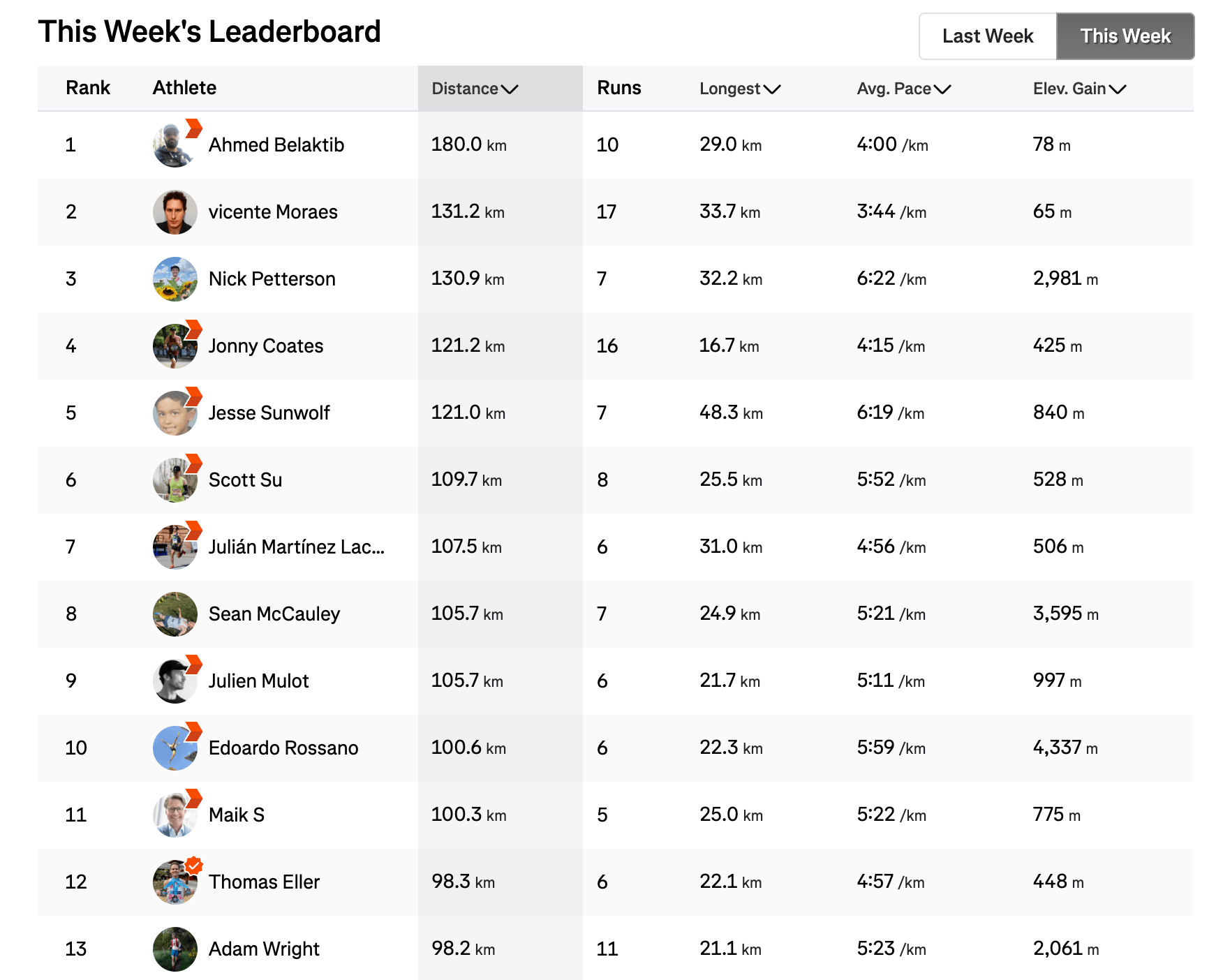
Satisfy is a trail-centric brand with a primarily trail-runner customer base, but 83% of trail runners also run road. One of its sponsored athletes - Max Jolliffe - is described as moving between “ocean, road, and alpine terrain with the same total commitment.” Last week’s Strava leaderboard showed 3:44/km road pace and 6:22/km trail pace, plus elevation gains from 65m to 4,337m. Road and trail are being run by the same community, all brought together by one brand.
Satisfy’s Strava club has 21,647 members. If only 20% are buying dedicated road shoes at $200 or more, that’s over $850,000 in annual footwear revenue going elsewhere. Against an €11 million revenue base, that adds up - and it carries no acquisition cost, because the customer already exists.
Which is why the Adizero Adios Pro 4 x Satisfy at $300 makes sense from a numbers perspective. It’s a performance product for a community whose identity is built around exactly this kind of running. The launch post has comments such as, “Where’s the shirt at?” and “MothTech Tee?” A demand signal from members of the existing community already asking to spend more.
The investor case for the collab
As mentioned above, Satisfy’s financial filings showed a €620,000 loss in 2022, debt growing to €4.3 million by February 2024, and cash reserves dropping to €305,000. In 2024 it doubled revenue to €11 million and gained €11 million in new investment.
The adidas collab fits Satisfy’s financial position precisely. It’s growing at revenue level but doesn’t have the capital to deepen its proposition independently. Using adidas for the share of wallet strategy isn’t commercially elegant as much as it’s commercially necessary.
Antoine Auvinet, who led the Series B and set the €100 million target, left Satisfy in May 2026. Brice Partouche is now CEO again, and as Creative Director and Founder, this means he’s responsible for both the brand’s creative identity and its commercial decisions. That alignment is either the strongest possible protection for what Satisfy has built, or an indication that the €100 million ambition has lost its dedicated commercial architect. We’ll see which it is as the next couple of years unfold.
For the investors who put in that €11 million - Bpifrance returning for the Series B, alongside 1686 Partners and undisclosed investors - the collab arrives at exactly the right moment. A €100 million target in five years from an €11 million base is a high-conviction bet on a tight timeline, but the capital-light partnership taps into the highest-yield category in running (road), supports a share of wallet model, and keeps the brand architecture intact. There’s reason to be confident in the structure.
The calculations behind the community
The community’s reaction was culturally understandable. adidas is one of the two largest sportswear companies in the world - of course Satisfy’s community pushed back. But Satisfy isn’t trying to become adidas.
It’s using adidas to become more Satisfy. To deepen its service to the same people, across more of their running week. The Pro 4 is a marathon shoe, and Satisfy is a long-distance brand. The product coherence is there if you look at it commercially rather than culturally.
To see how the collab unfolds outside of the cultural conversation, keep watching these three indicators:
Drop frequency: if it moves from seasonal to monthly, the scarcity architecture has been sacrificed for volume.
Price premium erosion: the collab currently commands a $50 premium over the standard Adios Pro 4 - if that gap closes, the value signal is weakening.
And most importantly, Satisfy’s own full-price sell-through on its independent range. If the adidas-distributed product starts doing the commercial work that Satisfy’s own product used to do, the brand layer hasn’t been protected - it’s simply been rented out.
These are the metrics that tell investors whether the commercial upside is being realised.
If this was worth your time, forward it to someone who’d find it useful. If you’re working through something similar, reach me at suzannah@strongbrandstrongbusiness.com
This content is produced for informational purposes. It does not constitute specific business, commercial, or strategic advice for any individual organisation.