Strong Brand Strong Business
Puresport has built a business where the brand decisions are the P&L decisions
Seven years, £5m raised, zero compromise on customer quality. Inside the architecture that makes Puresport's brand and P&L the same decision.
At a glance
£3.6m raised April 2025, led by Redrice Ventures and Five Seasons Ventures, bringing total investment to over £5m. Finn Russell and Ben Earl - investor-ambassadors since 2022 - also doubled down on their investments.
Over 45,000 runners attended Puresport community events in 2024. The brand operates run clubs operate across five UK cities and New York, and they’re all free.
SportsShoes.com listing announced in April 2026, selected on community alignment - as evidenced by the partnership going live just before the London Marathon. The specialist retailer was Puresport’s first retail partnership.
Boots listing confirmed in June 2026, after CEO Daniel Temm turned down multiple major retail listings over five years. It’s the brand’s first general retail partner.
Puresport was founded in December 2018 by professional rugby players Grayson Hart and Adam Ashe. They’d spent years managing career injuries with heavy opioid-based painkillers for quick relief. They wanted an alternative that was natural, effective, and certified safe for professional athletes - but there wasn’t anything on the market. So they built what they needed.
They started with a single CBD roll-on, gradually earning the right to extend into electrolytes, energy gels, and creatine - but only once they’d proven that they weren’t the only ones with their problem. They also started a run club, although it only had ten people to begin with. It was then another seven years until they signed with their first retail partner.
While most founders share Puresport’s founding conviction, turning it into a successful business has required elite commercial discipline - which is a much rarer skill.
Acquisition cost is operational, not algorithmic
The UK sports nutrition category runs on paid social. Meta ad costs for UK vitamin and supplement brands have climbed roughly 14% year-on-year, and from July 2026 an additional 2% location fee pass-through will apply to all UK-delivered ads. The market’s dominant players run monthly paid media budgets of up to £30,000 - though they’re manufacturing and selling enough volume that, as much as the additional charge will add further pressure to cashflow, it’s unlikely to be existential. Smaller brands have to find a different route. Fortunately, Puresport is one step ahead.
Puresport runs ads, but the heart of its acquisition model is its run clubs - the original ten-person office run that grew to 45,000 runners across five UK cities and New York. For the brand, the cost is operational across staff, the venues, and product sampling. But the benefit is that the runner who took Puresport electrolytes during a marathon where the brand is the event sponsor, arrives at their first purchase having already used the product under race conditions. By comparison, a paid social customer would have had no real association with the brand, the products, and how their own experience fits into it all - they’d have just clicked an ad.
The run club model has another advantage over paid ads when runners don’t convert. Missed sales in a community model are genuinely useful - if someone doesn’t convert at a club event, they’re standing right in front of the brand. That’s a feedback loop into product development, framing, whatever variable might tip it next time. In paid social, missed conversions have a cost and nothing else.
However, the run club can’t reach everyone, and this is 2026 so the world revolves around digital channels. Puresport's commercial discipline is visible here too. Paid ads, organic ambassadors, and an affiliate programme fill that gap. With a lot of weight behind the latter two, where there’s commission on conversion - so no sale, no cost.
The overall acquisition architecture is weighted away from high cash-commitment, low-conversion-confidence spend. That weighting is a commercial decision, not a brand one.
The ambassador tier is structured to outlast the trust problem
Consumer trust in paid influencer recommendations is declining across the UK market - 53% of consumers trust a recommendation less if the influencer was paid. For a supplement brand, the stakes are higher: the FTC tightened enforcement against unsubstantiated health claims sharply in 2024–25, a signal that reaches UK-facing content regardless of jurisdiction.
Puresport’s ambassador roster is a structural answer to this. Beth Potter is a 2023 World Champion triathlete. Jake Wightman is a 1500m World Champion. Lina Nielsen won European 400m hurdles gold. These are athletes with verifiable performance records and documented product use - their credentials do the work that paid endorsements can’t. Finn Russell and Ben Earl went further by investing in 2022, and doubling down in the April 2025 round. Their reputational stake in the brand is financial, not contractual.
The affiliate programme runs alongside: commission on conversion, no sale no cost. The ‘Gift It Back’ Black Friday campaign in 2024 - 500 empty boxes sent to influencers, redirected to charity, 2 million TikTok views in 24 hours - publicly critiqued PR gifting using the influencer network itself. A brand that can do that is not treating its creators as a media buy.
Five years of no. Then two very different yeses.
Daniel Temm announced Puresport’s Boots listing on LinkedIn in May 2026, noting the brand had been approached numerous times over the previous five years and turned them all down. The brand took its time - making sure the partnership was right before making the commercial commitment.
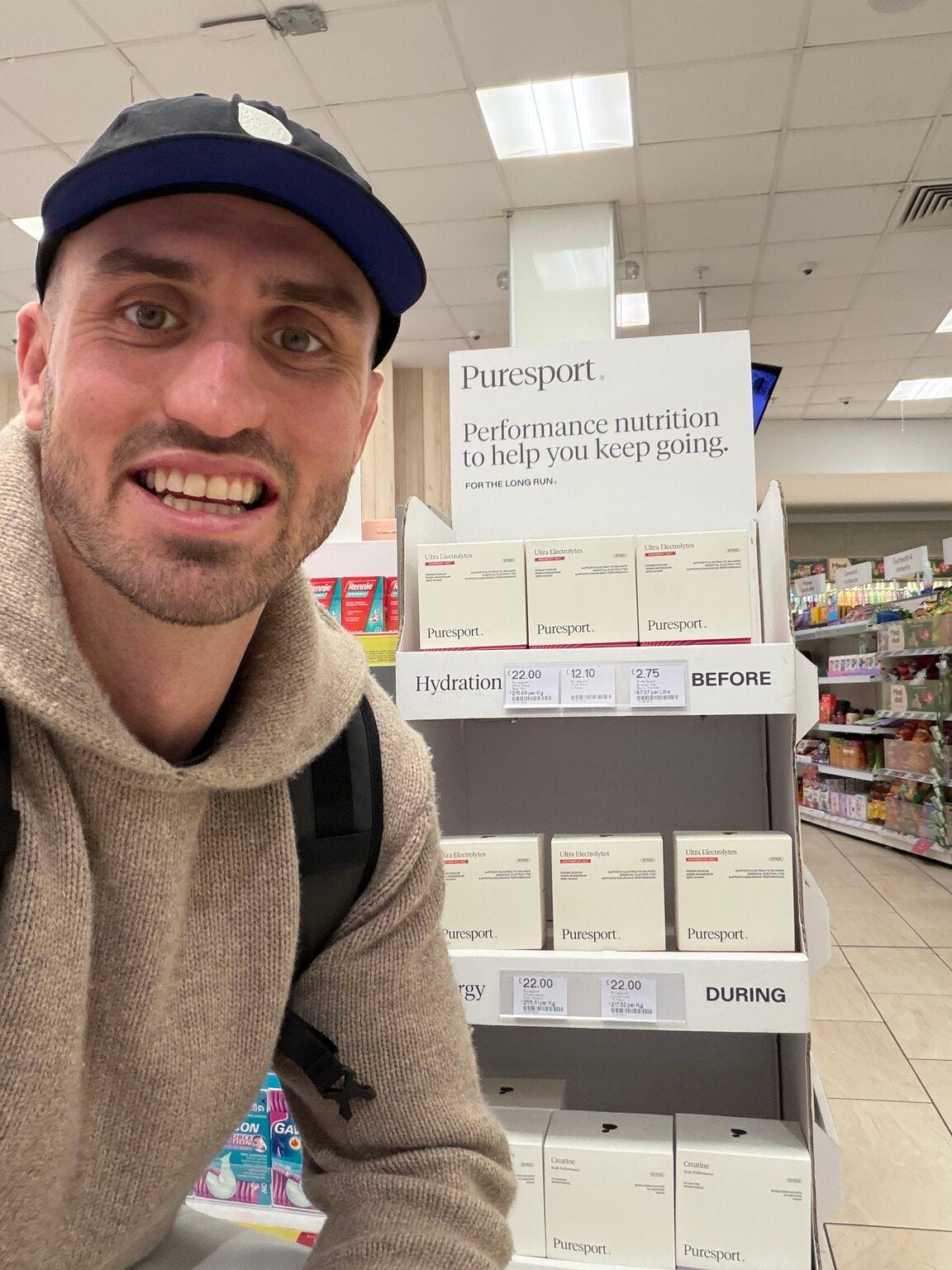
The month before, in April, Puresport had launched on SportsShoes.com. Clearly there was logic behind category alignment and customer access, but there was also alignment in how they approach community.
The month before, in April, Puresport had launched on SportsShoes.com. A specialist retailer with the same perspective that community has to be structural rather than a one-dimensional distribution channel. SportsShoes ran over 100 activation events in 2024, including marathons in London, Berlin, Boston, New York and Osaka. Their alignment is visible in the range - there are 21 Puresport SKUs at full price, comprising electrolytes in box formats of 15 and 30, energy gels, creatine, Vitamin D3, and the brand’s sports bottle. The box format is aligned to SportsShoes’ committed, returning customer.
Boots is a different proposition. The Puresport listing at Boots is eight SKUs - electrolytes, energy gels, creatine - included in Boots’ category-wide promotions, currently “buy one get one half price.” The customer who finds Puresport in the wellness aisle via a promotional offer is a different first encounter than the one reaching for it at mile 24 of a marathon. What they buy, how often, and at what price will tell Puresport whether Boots is a new customer into the category - or the same customer buying for convenience.
What investors actually backed
Puresport didn’t start by identifying a market gap - it started with a problem its founders had experienced first hand. They built what they needed, but with the commercial discipline to test and expand iteratively. To prove that their personal problem was a category problem worth solving.
They launched the CBD range first, then the performance nutrition range - both via DTC. In tandem, they started the run club, growing the community to 45,000 before a single retailer was added to the brand’s distribution network. That is their founding conviction and commercial discipline expressed sequentially across brand, product, and community.
The category has a real tailwind behind it. Mass participation events have seen 5–15% year-over-year increases, and the committed recreational runner - Puresport’s customer - is fuelling that growth. Redrice Ventures and Five Seasons Ventures haven’t invested in a brand. They’ve invested in a strong business that has proven its leading category position in a rising market
If this was worth your time, forward it to someone who’d find it useful. If you’re working through something similar, reach me at suzannah@strongbrandstrongbusiness.com
This content is produced for informational purposes. It does not constitute specific business, commercial, or strategic advice for any individual organisation.