Strong Brand Strong Business
Nike bet on the algorithm. The athlete won.
Nike cut 50% of its retail network to own the customer. Hill is rebuilding what the algorithm couldn't replace. The retail network lesson every brand needs.
In 2017, Nike made a commercial decision to restructure its retail network. The decision was informed by what attribution models could measure. Back then, this was a 2D view of the value chain.
These models showed retailers as a cost - Nike’s wholesale price was clearly lower than what the equivalent sales would return via direct channels. At the same time, they showed direct channels as efficient: this was when last-click attribution was in full swing (you can thank Google Analytics for that), and multi-click reports were relatively nascent. So crediting different channels for assisting customer acquisition wasn’t really a thing.
What the models also didn’t show was the value that a retailer was creating six months before a customer ever opened the Nike app. Last-click reports don’t account for the gait analysis conversation, or the product recommendation that turned a jogger into a committed runner who then told everyone within a 10-mile radius which shoe to buy.
Nike’s DTC decision was logical given the data available and the strength shown in its 2016 figures: +6% global revenue, +8% futures orders, 46.2% gross margin, 5-year 10% CAGR. It had good reason to be bullish about its brand dominance, and confident that it could cut its intermediaries, own the customer relationship, and capture the margin.
But it failed to consider that algorithms serve the athlete - not the other way around. All of those numbers were outputs of a brand system built on many diverse inputs - getting Nike in front of athletes, into conversations, and into spaces the models never measured. The competitor brands that stayed close to athletes when Nike pulled back proved it. On, Hoka, Brooks, and New Balance built specialist retailer credibility in Nike’s absence, and they’re now firmly embedded in the same network Nike is trying to rebuild.
We’re 18 months into Nike’s much publicised correction, led by CEO Elliott Hill. He’s a veteran from its glory years, and his approach is straightforward: put athletes back at the centre. While the headlines seem fixated on the lagging numbers, Nike’s Q3 FY2026 results provided the first measurable evidence that his plan is working.
This article gives you a brand-meets-commercial explanation of what went wrong, and how Hill is getting the brand back on track. I lived through the entire roll-out from various “how’s this going to hit our top line” perspectives - retailer, brand, agency serving the brand. But really, use this big Swoosh-shaped story as a lesson in retail network management. I’ve pulled it together at the end - it applies at every business size.
Why Nike’s DTC logic made sense - on a spreadsheet
In 2017, Nike announced that it wanted its DTC revenues (NIKE Direct) to reach 50% of total sales within five years, by severely cutting its retail network. The industry knew this was a significant escalation - even a 20% DTC split was considered the higher side of normal back then.
Nervousness ripped through the industry. I’ve worked with retailers who had Nike sales as 73% of their footwear revenue, and suddenly that level of exposure went from being a business risk to a very real threat. Leadership teams spent days locked in boardrooms - everyone trying to work out how to fill the millions in lost revenue that Nike’s exit would leave. Losing direct sales was the obvious problem, but the incremental Nike-customer sales they’d been getting would also evaporate.
It was a very different story Nike-side. In 2016, the business was generating approximately $89 million per day, with 74% of those sales through wholesale at structurally lower margins. The business was in what I’d call its “peak Emotion by Design era” - the period when Greg Hoffman was CMO (he retired in 2020). Hoffman’s approach, as he explains in Emotion by Design, was “the ability to create stories, images, and experiences that make people feel that even their most audacious dreams are possible to achieve.”
The brand’s 2016 “Unlimited You” video to see how this came to life. Within running, think Breaking2 (2016), run club sponsorships, city centre events - including Unlimited London, with Mo Farah at Oxford Circus, Barry’s Bootcamp workshops, and a Niketown takeover.
It’s worth noting that 2016 was an Olympic year - Rio. Sales typically lift in the months before and after, then reset. Who knows whether these 2016 numbers were part of a hype-cycle, thus creating a skewed degree of confidence. What we do know it that, going into 2017, the numbers validated Nike’s belief that its brand was strong enough to pull customers into its direct channel on its own.
The DTC strategy was announced in June 2017 by then-CEO Mark Parker as the Consumer Direct Offense (US spelling), and accelerated from 2020 under John Donahoe. At first, it went to plan - between FY2019 and FY2023, NIKE Direct grew from approximately 31% to 42% of total revenues. Nike attributed the growth to two things: cutting wholesale accounts by over 50% and redirecting resources toward owned digital and physical stores.
Who Nike cut - and who moved in
Nike cleared out retailers it described as “undifferentiated” - including Zappos, Dillard’s, DSW, Urban Outfitters, Macy’s apparel, Big 5, and Dunham’s Sports. Even the accounts Nike kept weren’t immune - Foot Locker’s Nike concentration fell from 75% of product spend in 2020 to 55% by late 2022. This was explained as an intentional move to reduce dependency on one brand, but it’s reasonable to question whether it was a defensive move by Foot Locker as a response to the overexposure problem retailers were experiencing, or an offensive move by Nike curtailing distribution and allocation - or a mix of both.
One runner, speaking to me directly, put it plainly: “You only had to walk into a running store and see shelves abandoned by adidas and Nike in favour of their fewer and better strategy. The truth felt by the running community was betrayal. Being forced online or into London with the ridiculous expenses that added. And the gap was filled by Hoka, On, and other - newer - brands.”
That word - betrayal - is doing a lot of work. For the community, the running store more than a location where they could buy their shoes - it was a cornerstone of their local running community. When the shelves emptied, the community didn’t wait for Nike to come back. It moved to the brands that stayed. Nike wasn't alone in this - adidas made similar consolidation moves - but as the dominant brand in the channel, Nike's absence was felt most.
From a brand stewardship perspective, Nike’s retailer consolidation was logical. A fragmented retail network creates genuine problems: inconsistent product presentation, off-brand environments, price erosion across channels. It was obvious within the industry where Nike’s brand wasn’t being presented with the polish that their HQ investment in marketing deserved. We all did audits on each other - even just to keep tabs on who was getting what stock and trading at what price. Nike’s allocation rules very clearly indicated who was on their “valued partner” list. Heavy discounters were very much not.
Clearly, the decision to cut some accounts was right. But what the subsequent results suggest is that the framework for deciding which ones wasn’t sufficiently developed. By treating “undifferentiated” as a single category, the useful and the useless went together - accounts diluting brand presentation lumped in with those building brand belief through customer discovery, athlete relationships, and acquisition work in communities Nike’s own channels weren’t reaching. Some accounts were limited by resource, and would have benefitted from additional brand support. Asking “why” before cutting might have served Nike better than a blanket label.
Nike knew that exiting a retailer meant that retailer would backfill with another brand. What appears to have been underestimated was how quickly On, Hoka, Brooks, and New Balance would use that space to build structural credibility - embedding themselves in the same specialist retailer network in ways that are now genuinely difficult to displace.
In specialist running channels, the competitive picture has shifted considerably since Nike’s 2016 heyday. Brooks now holds the number one position in adult performance running footwear at US retail, with Hoka and New Balance both gaining significant ground in the accounts Nike closed.
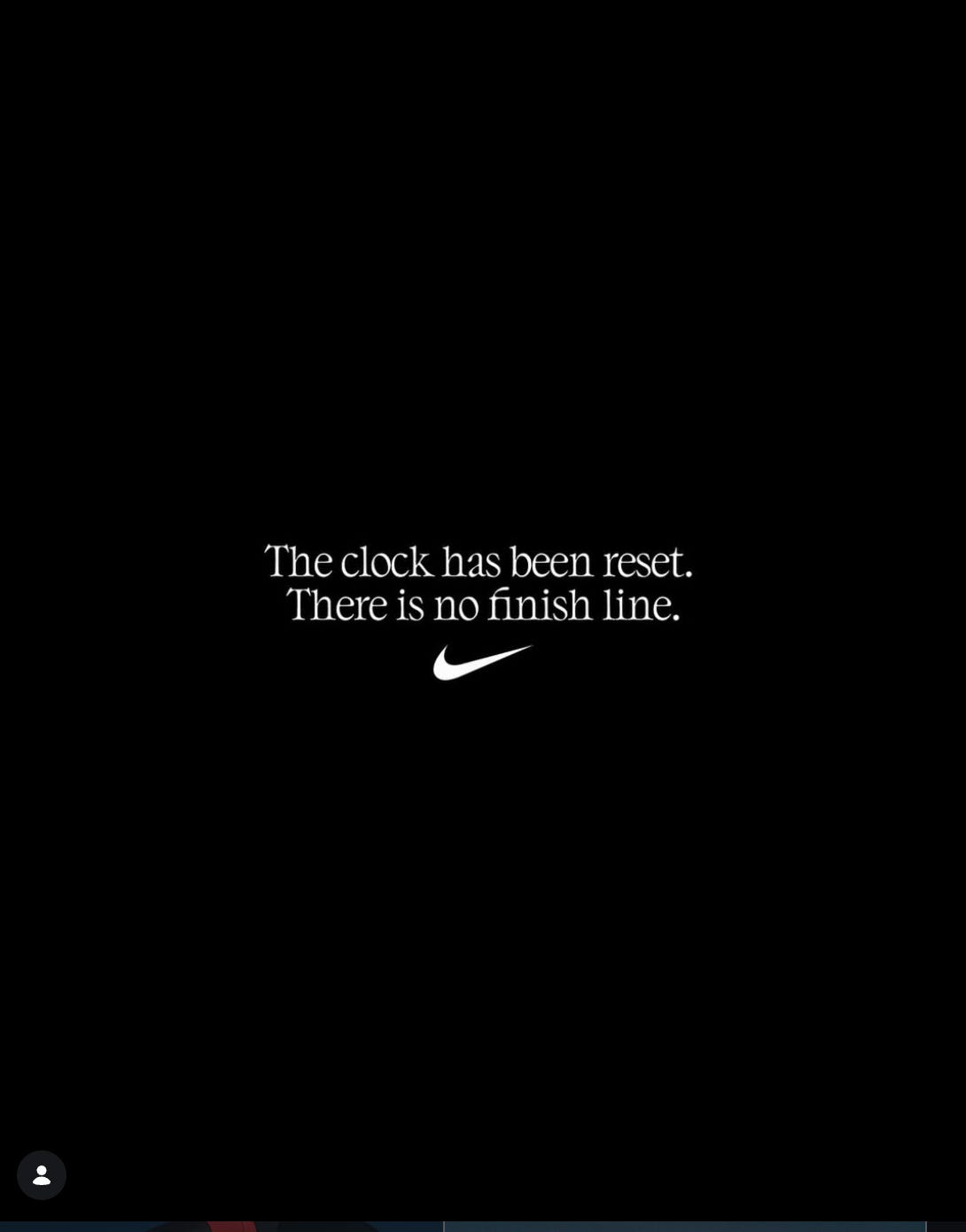
adidas is also making a case that brand performance credibility is still up for grabs. In 2017, Nike invested heavily in Breaking2 - a controlled, closed attempt on Monza with Eliud Kipchoge. The total spend was never disclosed but the production value, timing infrastructure, and athlete programme made it one of the most expensive R&D-meets-marketing exercises in the sport. Kipchoge ran 2:00:25, outside the two-hour mark, and not in World Major conditions. Yesterday, at the 2026 London Marathon, Sabastian Sawe ran 1:59:30 - the first legal sub-2 hour marathon in a sanctioned race. Kejelcha finished second in 1:59:41. Both in adidas. Nike acknowledged it on Instagram: “The clock has been reset. There is no finish line.” Nine years after Breaking2 - and Nike started the carbon shoe era that made it possible - adidas got the headline.
The key point: Nike voted itself out of the network that gave rise to its competitors. It’s the same network it’s now trying to rebuild - but share of shelf, wallet, and mind has already moved.
Retail networks are value creators, not cost centres
The challenge that Nike’s attribution model created was that it didn’t show the un-trackable, indirect inflection points a retailer provides - acting as the trusted advisor who puts the right product in front of the right person and explains why it matters. Algorithms convert that belief. They don’t create it. The cost of dismantling the channels where belief is created isn’t visible when you make the decision. It shows up in the following quarters and years.
Before any channel restructure, map each retail partner by the specific value they provide. These types are not interchangeable - losing one can’t be compensated by spending more in another:
1. Belief formation. The retail partner doing the gait analysis, the product education, turning a jogger into a brand advocate who tells everyone they train with which shoe to buy. Their value won’t show up in full on a sales report or last-click attribution - it appears later, when customers search specifically for your brand. Think of it as a longer, slower demand pipeline. If you need metrics, track search volumes by city and cross-reference with your highest-performing specialist accounts.
2. Community access. Retailers embedded in the specific community the brand needs to reach. A digital channel reaches the demographic. The community requires physical presence - someone in the room, on the course, at the event. Pull back from investing in these accounts and you lose presence in the conversations that precede purchase decisions.
3. Category credibility. Specialist retailers whose act of stocking the product is itself a signal. Being ranged by a serious running specialist communicates technical authority that a brand’s own website doesn’t - because the specialist is putting your product on a shelf that could have held a competitor’s. The value is in you being there instead.
4. Discovery. Curated retailers whose selection introduces the brand to customers who would never have found it through owned channels - first-touch acquisition at the retailer’s cost, not the brand’s. Hill is applying this directly: ACG - Nike’s outdoor performance brand, now being rebuilt under its own identity within the portfolio - launched its retooled LDV shoe exclusively through Huckberry on April 16, 2026 with global release following seven days later. The exclusive window prevents price matching, protects full-price margin, and preserves scarcity as the product rolls to wider retail. This is a capital allocation decision that has specific margin consequences - it should not be defined as being a superficial brand gesture.
5. Clearance management. A designated clearance partner absorbs end-of-lifecycle stock without exposing full-price customers to discount signals. Nike cleared inventory on its own channels, directly in front of its highest-intent customers, conditioning them to wait for promotions. The margin loss isn’t just on the discounted unit - it compounds across every subsequent purchase the same customer now waits to discount.
You also need to know what your highest-intent customers look like by account. The retailer who’s only trading well because they put big red discount signs next to your products is a different problem to a high-performing specialist who’s converting at full price. One is a clearance utility, and one is a belief builder - but both have a role. Neither should be managed the same way.
What the retail partner was absorbing - that the brand now carries
There’s a side to this that doesn’t show up in the margin calculations, and it only became visible to Nike when the accounts were gone.
Wholesale partners take ownership of stock, so inventory risk sits on their balance sheet, not the brand’s. Bulk delivery to a finite number of locations costs a fraction of individual-address last-mile logistics. Their customer service headcount covers product queries for every brand they range. Nike’s own filings document the consequence: operating overhead attributed to “NIKE Direct variable costs” grew through every year of the DTC era.
There’s also a leverage point most brand teams leave unmapped. A brand with genuine pull in a retail account - the kind that drives a meaningful share of that retailer’s category and consistently introduces new customers - holds commercial assets beyond the wholesale margin. The retailer’s marketing team, under brand approval frameworks, can produce and distribute co-branded content at the retailer’s cost. New customers introduced by that retailer arrive without acquisition spend from the brand. And if the brand’s DTC infrastructure picks up the second purchase, that transaction is at zero CAC. Nike at its peak held this position across the specialist accounts it subsequently cut.
Before modelling any channel shift, add back what the retail partner was carrying: inventory risk, last-mile versus bulk logistics, returns processing, customer service headcount. Nike’s FY2025 net income - $3.2 billion, down 44% - is what the full picture looks like when those inputs are missing from the model.
What Hill is doing and what the headlines are missing
Elliott Hill returned to Nike as CEO in October 2024. He’d spent 32 years at the company before leaving in 2020 - which means he knows what Nike looks like when the athlete is at the centre, because he was there when it was. His plan isn’t complicated: get back to sport, rebuild the specialist channel, stop the lifestyle franchise from eroding the performance credibility. The Sport Offense, as it’s called internally, is exactly what it sounds like - an offensive move, led by sport, in the channels where athletes actually shop.
On the Q3 FY2026 earnings call, Hill said: “NIKE Running was the first team to move into the Sport Offense. They created a clear product construct based on athlete insights, segmented and differentiated assortments across an integrated marketplace and elevated our presence in story talent at retail. The consumer is feeling the impact of the full offense with NIKE Running up over 20% for the quarter.”
Running was already growing as a category - On, Hoka, and Brooks all posted strong numbers through the same period. Nike’s 20% isn’t just tailwind. What matters is the composition: growth at full price, through rebuilt specialist retailer relationships, led by new performance product. That’s the channel rebuild working.
The financial data has a cultural counterpart not yet in the results but producing the next set. In 2025, Nike launched the After Dark Tour - a global women’s nighttime race series, reviving a format it ran from 2005 to 2015 and then abandoned for a decade. 50,000 women across five continents in the inaugural year, one in three of whom had never run a race before. Women’s running search interest in the US is up 200% over the past twelve months, per Running Industry Alliance data. Nike isn’t creating that interest - it’s showing up inside it.
A Nike director told Modern Retail in October 2025: “I would say Nike started the running club culture, but we completely stopped, and then everybody else took it over. We’re slowly coming back into it.” As honest an internal assessment as you’re going to get. Nike built the culture through athlete communities. The algorithm took over, and the athletes followed the brands that showed up.
North America wholesale grew 11% in Q3. In February 2026, Nike posted positive growth in all channels simultaneously for the first time in two years. These are the signals the headlines are reading as noise.
What the Q3 FY2026 numbers actually show
Before getting into the current numbers, the cost structure tells its own story.
When Nike removed over half its wholesale partners, it accepted significantly more inventory exposure. When demand shifted, and supply chain disruption from COVID compounded it, that exposure became a material balance sheet problem - more product stuck on the warehouse floor than anticipated, concurrent with manufacturing commitments it couldn’t unwind quickly enough.
In the old wholesale model, retailers typically carried a meaningful share of total inventory in Nike product. In my experience, often 10 to 30% and in some accounts considerably higher. The overexposure problem still existed - it just sat on the retailer’s balance sheet, not Nike’s. That arrangement gave Nike strong cash conversion velocity and zero warehousing cost, with reduced margin being the price paid for that security. The DTC model removed that buffer and put the full operational load back onto Nike.
In December 2023, Nike announced a $2 billion cost programme - the admission that the owned infrastructure was carrying a fixed cost base the revenue couldn’t support.
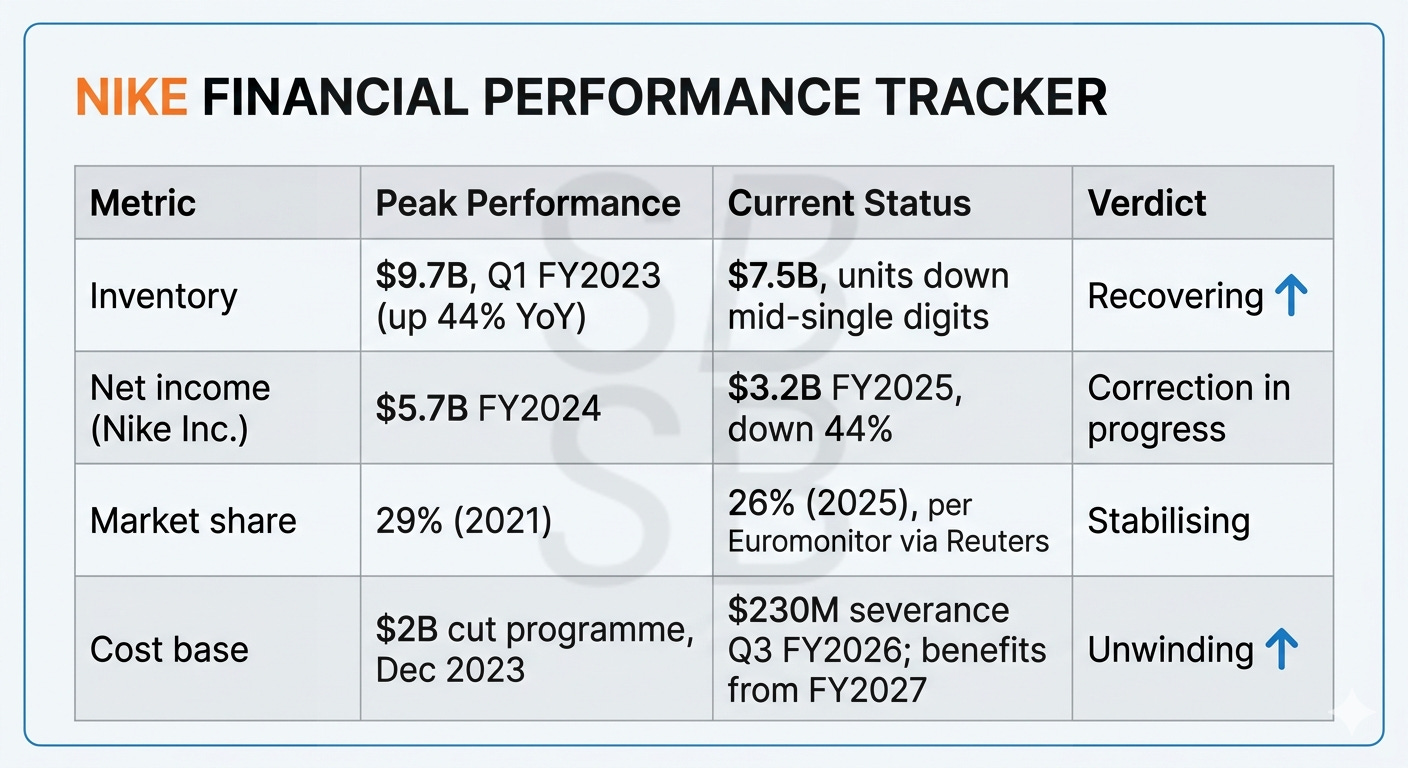
The Q3 FY2026 headline - total revenues $11,279 million, flat on a reported basis - isn’t the full picture. Remove Converse from the consolidated result and Nike Brand revenue was $11,012 million, up 1% on a reported basis. The “flat Nike” read conflates two different commercial situations into one number. Converse posted a $40 million operating loss in Q3 FY2026 against a $39 million profit the prior year - it’s dragging the portfolio number down. Remove it and the Nike Brand correction is measurable and underway.
On inventory, the $7.5 billion current figure is a $2.2 billion reduction from the $9.7 billion peak. The $230 million Q3 FY2026 severance charge - the largest single restructuring charge under Hill - was specifically targeted at supply chain and technology headcount built to support the DTC model. CFO Matt Friend confirmed benefits begin flowing in FY2027.
These numbers are not signs of ongoing deterioration and suggest the early signs of a turnaround. They are the cost of the correction showing up in the current quarter while the recovery builds in the next one.
Hill’s turnaround scorecard - against his stated two-year timeline
Wholesale restored and growing for two consecutive quarters ✓
Running up 20%, full price, through specialist channels ✓
North America all-channel positive for the first time in two years ✓
Over $4 billion of lifestyle inventory deliberately removed from peak ✓
Inventory at $7.5 billion from a $9.7 billion peak ✓
Largest restructuring charge taken; benefits flow from FY2027 ✓
Spring 2027: first sport offense product reaches market ← ahead
World Cup: 5,000+ football doors elevated on home turf ← ahead
Gross margin expansion: Q2 FY2027 per management guidance ← ahead
He is on schedule. The schedule is not yet visible in the lagging numbers.
Brooks had Berkshire Hathaway. Hill has the same discipline - and deserves the same read.
Jim Weber’s turnaround of Brooks Running - the principle behind it and the commercial results it produced - is covered in this previous edition (“How Brooks Running Earned a 14% CAGR Through Specificity”). What I want to draw upon here, within the context of Nike, is a structural comparison. With Brooks, Weber’s principle was to serve the runner, not the demographic, not the channel, not the quarterly target. With Nike, Hill’s is the same.
Brooks has been a Berkshire Hathaway subsidiary since 2006. The structural gift Berkshire provided wasn’t immunity from difficulty - Weber took revenues from nearly $70 million down to $20 million before the focus started paying, and that is not an easy road. What Berkshire gave him was the absence of quarterly accountability while he did it. He didn’t have to give earnings call every ninety days, or spend time answering analysts’ questions about when the numbers would improve. He was given the time and trust to let the strategy work.
Hill doesn’t have that. He’s correcting a $51 billion business - Nike Inc. FY2025 revenues $46.3 billion, peak $51.4 billion in FY2024 - while managing over 1,000 retail relationships globally, three brand entities, and quarterly earnings accountability to institutional investors reading the lagging numbers, not the leading ones. However, the discipline follows the same logic as Weber’s: serve the athlete, through specialist channels, without flinching when the quarterly numbers make the case for doing something else. The difference that Weber wasn’t answerable to a quarterly clock while he got to work - whereas Hill is.
When Hill said on the call “I think everybody, when I came into this role, said it’s going to take two years, and that’s where we’re tracking right now” - that is not expectation management. He closed his prepared remarks with an image from visiting Camp Nou during Barcelona’s reconstruction: scaffolding above the pitch, cranes in the corners, sections unfinished, players still competing. “This is Nike right now.” Not the language of a CEO softening a warning.
I find myself wishing that patience extended to public company leaders attempting the same correction. Patient capital reads the leading indicators, while the quarterly reporting schedule reads the lagging ones.
Three things to do before you next review your retail network
Map by value type, not margin contribution. Before any account reduction, work through each retail partner against the five value types in the free edition. A low-revenue account providing belief formation or community access in a key segment may be generating more future demand than a high-revenue generalist providing none of those things. The cost of losing it won’t appear on this quarter’s P&L. It’ll appear in three years, and by then the causal link is almost impossible to trace.
Model the full cost shift. Add back what the retail partner was carrying: inventory risk, last-mile logistics differential, returns processing, and customer service headcount. The gross margin advantage of going direct is real - but run the numbers with those inputs included. Nike’s FY2025 net income is what it looks like when you don’t.
Map your commercial leverage in every significant account. Marketing resource, new customer introduction, second-purchase capture at zero CAC - none of these appear in the wholesale margin calculation, which is why they’re consistently left out. Quantify them before deciding the account is dispensable. You may find it’s doing significantly more commercial work than the margin line suggests.
Of every retail partner in your network, ask what specific value type are they providing, what costs are they absorbing, and what commercial leverage do you hold in that account? The algorithm will not tell you - your customer will.
Strong Brand Strong Business is published for founders, CMOs, and senior operators in brand-led businesses. Every edition examines a brand building something that lasts - and what the rest of us can learn from how they do it.
Content is produced for informational purposes. It does not constitute specific business, commercial, or strategic advice for any individual organisation.