Strong Brand Strong Business
"Follow the money": How NEXT builds brand-led businesses
Practical lessons from NEXT for any brand-led business. How to keep money at the centre of a brand-led business without hollowing out the brand.
Key takeaways
NEXT made £1,158 million of profit, up 14.5%, on nearly £7 billion of sales for the year ending January 2026.
Its rule is “follow the money”, where every activity - be it marketing, product, stores, or technology - has to earn a commercial return, or it doesn’t get funded.
It buys strong brands with broken businesses (e.g. Joules, Reiss, Cath Kidston), fixes the business, and keeps the brand intact.
It protects the concept that distinctiveness creates margin, but knows that capturing that margin depends on having sound infrastructure.
The lesson for any size is to tie every activity to a return, and put something operationally sound under your brand.
NEXT is one of the UK's largest clothing retailers, with sales of nearly £7 billion. But how does it actually make its money?
I’ve read all 80 pages of its FY26 results to understand the layers of value creation that sit between its ads, its products and its bottom line. What comes out are two clear lessons in how NEXT makes decisions across brand and product so they lift the P&L. The discipline behind £1,158 million of profit, up 14.5%. How it approaches - and fixes - broken brands. And what any business, at any size, can take from it.
This is how Simon Wolfson, NEXT’s long-standing CEO, runs brand, product and profit as one value-creating system.
Understanding the business means understanding the man - and his mindset
Wolfson has been leading NEXT for around 25 years, making him the longest-serving CEO in the FTSE 100 (he was actually the youngest, when he took the role at 33 years old, in 2001). Though his story with the retailer started a decade earlier.
Back in 1991, even though his father was the Group’s chairman, Wolfson started on the Kensington shop floor as a sales assistant. He also completed a law degree at Trinity College, Cambridge.
So a lot of what NEXT does comes from a deep, first-hand knowing of the business' dynamics and characteristics, and an understanding of the need for defensibility when making decisions. I think that really comes through when you review NEXT's results. It isn’t clear whether he wrote the 2026 result, although he wrote the previous year’s ones. Wolfson's thinking and his way of communicating it are all over the document - it's narrated to be understood quickly, without flattening the impact of the commercial data.
NEXT is not your usual retail group. It doesn’t treat a brand-led business as a single brand-and-commercial system when it buys one. It clearly separates the two, only buying strong brands with broken businesses. And then, once the acquisition is complete, it returns them to profit by bringing those two halves back together.
I’m going to be explaining two ways it does this in just a little bit. But the thing that makes NEXT’s approach so interesting, is that it can be applied to businesses of any size, in any industry.
Every activity has to earn its return - including the creative ones
Even though NEXT is, anecdotally, increasingly present across social media ads, and it’s now normal to see it swapping plain tees for trend-led styles, it makes sure that there’s zero ambiguity around the activity’s contribution to profit.
It doesn’t matter if it’s marketing, product, stores, or technology, each is tied to a commercial outcome. The Group is on-record for saying that it grows by following the money, and it won’t back projects that only sound strategic.

There’s a lot of cost discipline that goes on behind the scenes that gets lost behind the big profit headlines. Marketing is the obvious one - NEXT won’t spend on advertising below a return of £1.50 for every £1. And the same discipline extends into the product itself. NEXT now works directly with mills and spinners to improve fabric quality even before a garment is designed, because better fabric means it can charge more. We can say this as a fact, as the results stated that customers traded up to better-quality items last year, lifting average selling prices by 2.5% with no discount attached. Even new stores are judged against a hard return hurdle rather than revenue by square footage.
The lesson isn’t to copy those exact numbers. It’s in approaching marketing, product and technology decisions as commercial decisions. You can have confidence in your costs when there’s a clear path to return - but you also have to know where to draw the line. In fact, buried in the results, there’s an admission that, “Gone are the days of replacing a perfectly good floor finish because it is not ‘on-brand’”. But as we’ll explore next, this isn’t about complacency or lowering your standards, it’s about keeping your cash position strong enough to invest where it really matters.
Distinctiveness creates margin - but it’s only captured if there’s sound infrastructure
NEXT’s cost control across marketing, product, and technology is making it a regular on the acquisition scene. In part because it has the cash to spend, and in part because it’s in a position to apply it’s same discipline to other businesses. It’s investments and rescue-buys are in brand-led businesses that are growth-capped, or that have fallen into administration, as a result of their operational costs and inefficiencies.
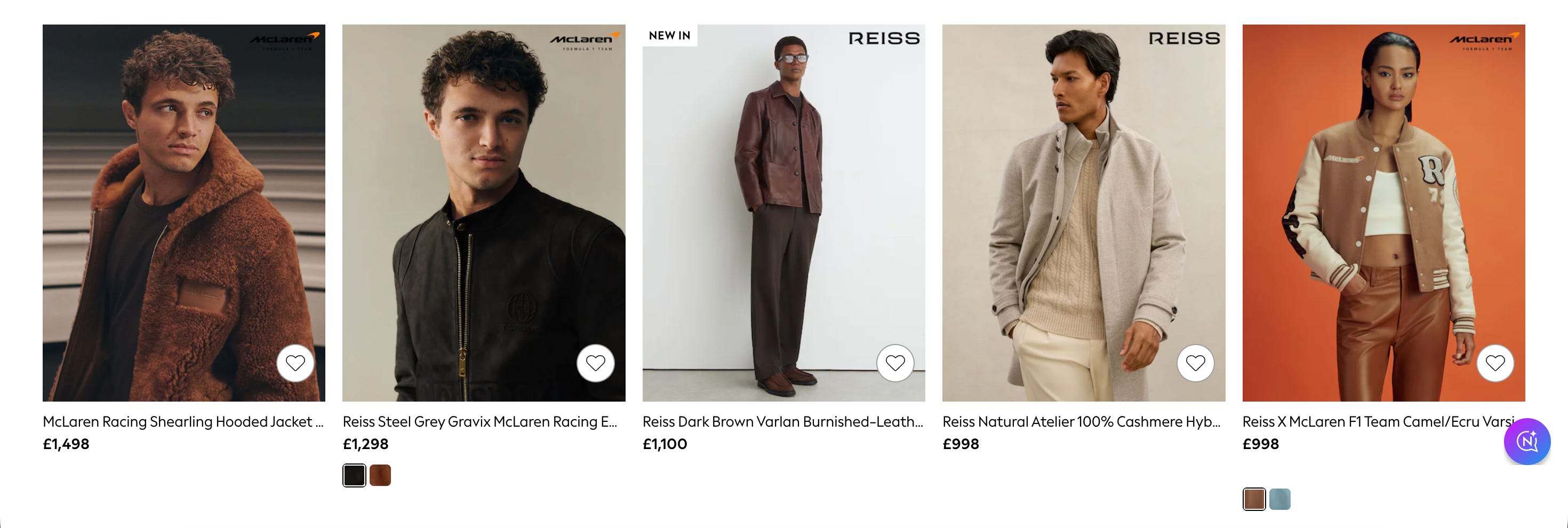
When it rescues a brand or when it’s investing in a brand, one of the judgements it makes is whether the brand still has currency. Take Reiss, where NEXT has gradually increased its stake up to a 74% majority control. The brand was profitable, but operational constraints were limiting its ability to push into the US and Asia. Or Cath Kidston, where YouGov polling showed that brand sentiment was still high, but the business couldn’t keep up with the cost of international expansion, and didn’t have the reserves to absorb the impact of COVID closures.
This approach is paying off. Reiss now drives £43.4 million of profit into the Group. And it sits on Total Platform - NEXT's proprietary infrastructure - which, together with the wider investment portfolio, contributed £89.7 million. More broadly, the wholly-owned brands and licences the Group runs are strengthening year on year, at a global net margin of 18.3%.
NEXT’s “infrastructure” is at the core of the business’ success. Total Platform is the warehousing, the websites, the delivery, the credit, and customer management - all the functions that a brand needs to trade, but that a small or broken business can’t afford to build. When NEXT buys a brand whose problem was operational, Total Platform is what fixes it.
You almost certainly don’t have a Total Platform, and it would be remiss not to identify it as being NEXT’s real advantage. But the lesson isn’t about the platform itself. The lesson is that a distinctive brand only works commercially if something operationally sound sits underneath it - whatever that means at your scale.
That’s NEXT’s “secret”. It knows that a distinctive brand can sit at a price a generic one can’t, so it only buys brands that still carry real value with customers, and then fixes the business, not the brand. Each brand is then run by its own independent team with its own targets, and one can’t see another’s commercial data. The point is to actively avoid the “Play-Doh effect”, where portfolios buy distinct brands and then mush them into a sea of same. It’s how the Group protects the value of what it bought - keeping the distinctiveness people wanted, then making it profitable by putting it on infrastructure that actually works.
So the lesson runs both ways. Protect the distinctiveness - defend the thing that earns the premium. But don’t mistake it for a business. A loved brand on a broken operation is worth very little unless there’s something commercially sound running underneath it.
So what can you apply from NEXT’s approach to building successful brand-led businesses?
This is only a sliver of what NEXT’s report offers. But the Group’s insistence that every activity has a commercial anchor, plus its habit of buying brands that still have currency but broken businesses that can be fixed, are useful lessons in managing the tension that often sits between the idea of a brand, its delivery through product, and actually capturing the commercial value.
NEXT doesn’t manage brand, product and business as separate things to be balanced against one another. It runs them as one system - the creative earns its margin, the margin funds distinction, and the discipline underneath makes sure it’s returning hard results.
And you can take something from that whatever size you operate at. Yes, NEXT’s specific moves are underwritten by infrastructure and a balance sheet you probably don’t have. But the discipline isn’t. And that doesn’t need a billion-pound profit line.
Frequently asked questions
What is Simon Wolfson’s “follow the money” approach?
Holding every activity - marketing, product, stores - to a commercial return, and refusing projects that only sound strategic. NEXT won’t spend on advertising below £1.50 back for every £1.
Does NEXT prioritise brand or profit?
Both, as one system. It protects each brand’s distinctiveness because distinctiveness earns margin, and holds that brand to the same commercial discipline as everything else.
Why does NEXT buy brands out of administration?
Because they still carry value with customers while the business underneath has broken. NEXT fixes the business and keeps the brand - as with Joules, turned back to profit.
What can a smaller business learn from NEXT?
The discipline, not the infrastructure: tie every activity to a return, protect what makes your brand distinct - including your people and your products.
This content is produced for informational purposes. It does not constitute specific business, commercial, or strategic advice for any individual organisation.