Strong Brand Strong Business
Lululemon reported $11 billion in revenue. Its home market is still shrinking
What the full year fiscal 2025 numbers say about customer clarity - and the governance fight that could reshape the board.
Two weeks ago, I wrote that Lululemon’s fiscal 2025 results, due on 17th March 2026, would be the next signal for where the business really stands. You can read that article here.
Now that the results have been published, I’ve pulled together this update to explain what they show, and where they sit relative to my previous article’s discussion. I’ve also flagged one thing the coverage is getting wrong.
What do Lululemon’s full year 2025 results actually show?
Lululemon published its results under a headline stating that they’d turned over $11.1 billion in full year revenue - and that this was up 5% on the prior year. The press release announced that Q4 came in at $3.6 billion, slightly ahead of guidance. Interim co-CEO Meghan Frank said that it was “ahead of our expectations” - and from a top line perspective, that’s fair.
But when determining a business’ health, the top line isn’t always the true story. That requires a look at what’s happening between the top line and the bottom line, and then what’s left in the company’s bank account.
Where is Lululemon actually growing in 2025?
Americas net revenue fell 4% in Q4 and 1% for the full year, with US revenue specifically down 6% in the final quarter and Americas comparable sales down 3% across the year. International more than compensated as an aggregate total, with China up 29% for the full year and total international sales up 15%.
This means Lululemon’s overall growth depends on its international sales underwriting its declining domestic sales - a structural risk, not a signal that the brand is in recovery.
What happened to Lululemon’s margins in 2025?
Gross margin slipped from 59.2% in 2024 to 56.6% for full year 2025, and fell further to 54.9% in Q4. Operating income was down 12% for the year, showing that day-to-day efficiency is also tanking. Profit per share (referenced as “EPS” in statements - worth knowing, as it’s a publicly traded company under NASDAQ:LULU) dropped from $14.64 in 2024 to $13.26 in 2025.
The 2026 guidance projects EPS of $12.10-$12.30 - even lower. That would make it three consecutive years of declining profit per share, raising real questions about shareholder confidence alongside the consumer confidence already showing up as decreased sales.
What is happening to Lululemon’s share price?
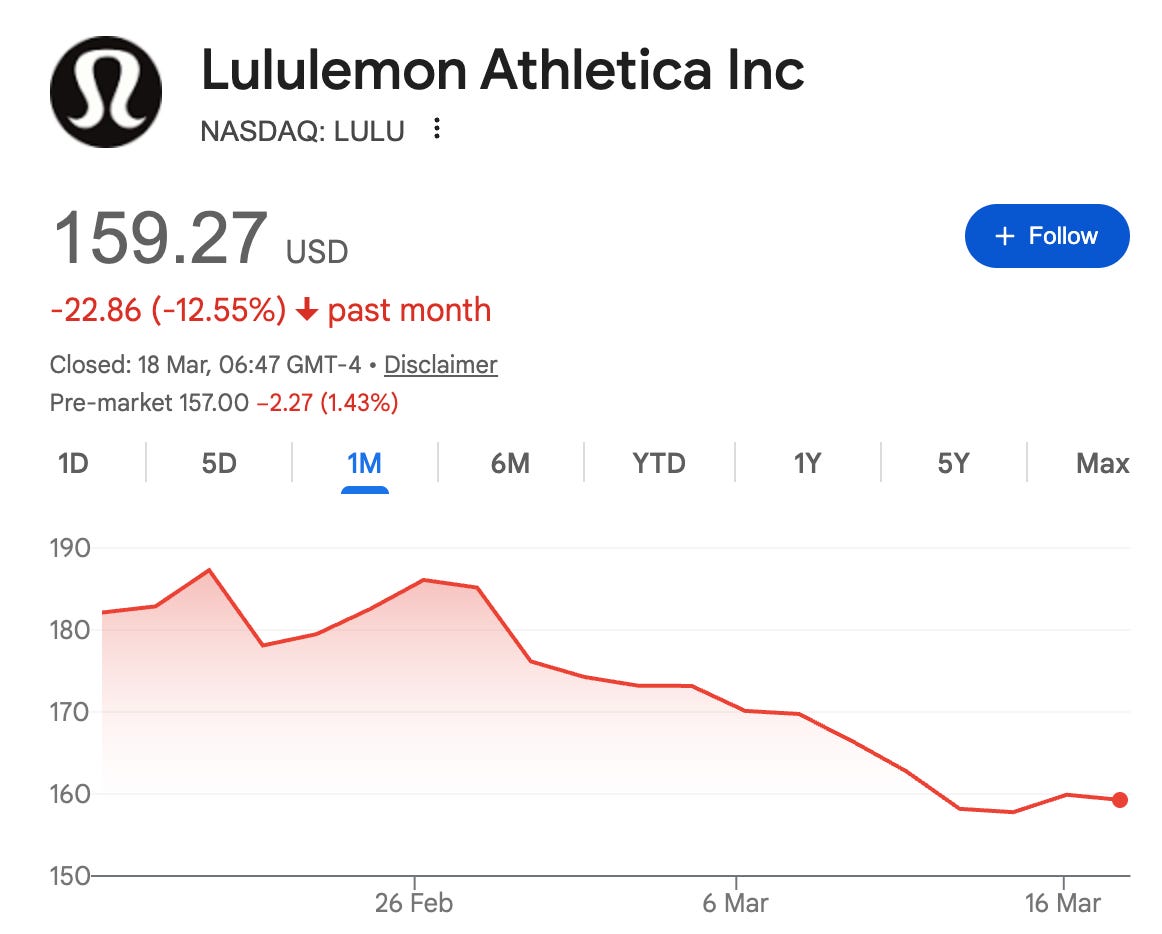
As the results landed on 17th March, LULU was trading near its 52-week low. The results did nothing to reinstate market confidence, and the forward guidance gives investors little reason to expect a near-term recovery.
What does Lululemon’s store expansion and share buyback programme signal?
In 2025, Lululemon opened 44 net new stores, ending the year at 811 locations globally, with another 40-45 planned for 2026. In the markets where the brand is growing strongly - China and Rest of World - that expansion is a reasonable bet on momentum. In the Americas, where comparable sales fell 3% in 2025 and the guidance offers no reversal, new store openings lock in fixed costs against a revenue base that hasn’t stopped declining.
Lululemon also spent $1.2 billion buying back 5 million shares across 2025, $269 million of that in Q4. Buying back stock at prices down >50% from their peak can be good capital allocation if the business recovers - it plays to the “buy low” part of “buy low, sell high,” creating the opportunity to gain more value per share when earnings rebound.
That logic only holds if the business recovers. Running store expansion and buybacks simultaneously while home market earnings are still falling is the tension worth watching, and cash ending 2025 at $1.8 billion - down from $1.98 billion a year earlier - tells you the balance sheet, while still solid, is moving in one direction.
Is Chip Wilson’s campaign really just post-founder syndrome?
As covered in my article on 5th March, Chip Wilson has publicly expressed his concern around how the business is being run, and what it means for both current shareholders and the brand long-term.
Fortune published a piece on 14th March framing the Wilson campaign as a case of post-founder syndrome - the charismatic founder who built something extraordinary and cannot accept that the business moved on. It’s a fair journalistic frame, and not one I’d considered.
It’s fair that Wilson has history: he left the board in 2015 following comments about women’s bodies that became one of the company’s worst-ever crises, and in the nine years after his departure, Lululemon’s revenue tripled. But what the post-founder framing doesn’t consider is whether his commercial argument holds.
A few days before the results dropped, Wilson posted on LinkedIn: “I have learned that passion alone does not make an effective business leader. That requires a Board that can guide, support and challenge you.” A board without brand and product expertise, overseeing a business whose premium positioning depends entirely on brand and product judgment, is a governance problem that exists regardless of who first named it. His case - that the current board is structurally unequipped to support an incoming CEO, and that board reform should precede rather than follow the CEO appointment - deserves evaluation on its commercial merits. I don’t personally care for the questions that surround his motives.
His three nominees - Marc Maurer, Laura Gentile and Eric Hirshberg - go to shareholder vote at the 2026 annual meeting, and how institutional shareholders read yesterday’s results will shape that vote.
What does this mean for anyone running a brand-led business?
The piece I published on 5th March argued that Lululemon’s financial decline was the commercial consequence of lost customer clarity - a drift in creative and product judgment that showed up on the P&L. Yesterday’s results reaffirm that position. Management’s own forward guidance doesn’t project a recovery in 2026, and a capital allocation pattern that keeps committing in two directions at once - buying shares while they’re cheap, opening more physical stores, while both domestic revenues and operating efficiency fall - is not the behaviour of a business that has regained solid ground.
When commercial pressure arrives, you have a choice. You can play to win - make the sharper creative call, recommit to the customer who built you. Or you can play not to lose, spreading cost and commitment across a broader base in the hope that volume covers the gap. Lululemon’s numbers, and the guidance, keep pointing at the same answer. You can’t buy your way back to customer clarity.
Strong Brand Strong Business is published for founders, CMOs, and senior operators in brand-led businesses. Every edition examines a brand building something that lasts - and what the rest of us can learn from how they do it.
Content is produced for informational purposes. It does not constitute specific business, commercial, or strategic advice for any individual organisation.