Strong Brand Strong Business
The gap between brand and commercial is where growth strategies fail
Glossier's Sephora expansion wasn't the mistake. Changing their hero product at the same moment was. Here's what the recovery teaches brand operators about growth.
Glossier was once one of the most hyped skincare and make up brands on the planet, but its last three years have been anything but beautiful. It’s become a poster child for what happens when brand and commercial fall out of sync - and what it costs when your community works it out before you do.
The short story is that Glossier launched, wanted to expand beyond DTC, added Sephora as a wholesale partner, played the right strategy but had the wrong product. The worst bit was that their community realised the error before they did - and the same social media conversations that built them up, were quick to tear them down.
This was back in 2023 and since then, the brand has been rolling out a recovery process that’s essentially the reverse of their original sequence, which put structure - Sephora expansion - before product.
The first step was fixing the product. The second was restructuring the business. The latter is still work in progress, and it has seen them hit headlines, with news that they made over 50 of their staff redundant. This might not sound much in a world where Google and Meta periodically lay off between 100 and 200 staff - but this is a different industry. As such, this translates into a reduction of 1/3. This might be surprising given they were such a highly visible, present brand, until you remember that they expanded through their retail partnership. This was the whole plan of increasing sales while being conservative about central overheads. Scaling, basically.
Their recovery process is what I’m discussing in this edition of Strong Brand Strong Business. Specifically, I’ll cover why their original sequence (structure then product) went wrong, how their recovery sequence (product-then-structure) differs, and give insights into how it’s going so far.
This article is about DTC to retail growth sequencing. I want you to use it as food for thought when you’re considering your next distribution move.
You’ll understand that planning your expansion doesn’t start with you asking which channels to choose - it starts with asking what your brand needs to be true before different channels can work.
As always, I’d love to hear your thoughts. Find me on LinkedIn or hit subscribe to get Strong Brand Strong Business sent to your inbox.
Before we get going, I want to anchor my perspective with a bit of “real world” context. I was in a room recently where the CEO of a £600M business and this was the question we were actively looking to answer:
“Does brand perception lead commercial performance, or does commercial performance fund brand perception? Or is it neither - and the real discipline is committing to both simultaneously and not letting one run ahead of the other?”
The answer to that question and the answer to Glossier's problem are the same thing. When brand and commercial move sequentially rather than simultaneously, a channel change will find the gap. Glossier's mistake wasn't to sell in Sephora - it was the order of the decisions that preceded it.
How did Glossier build one of the most distinctive DTC brands in beauty?
To understand Glossier as a brand and business, we need to go back to the beginning. Glossier launched in 2014 out of Emily Weiss’s beauty blog, Into the Gloss. It followed the ideal scenario of having a community before a product range - creating demand before switching on supply.
After testing physical retail via pop-ups, Glossier decided to commit to a permanent store. The commercial logic was there, given they’d already noticed that physical spaces were followed by a lift in local online sales - and they would take a city-by-city approach so it was by no means a reckless land-grab.
By 2021, Glossier had raised $266 million across six rounds at a $1.8 billion valuation. Investors loved what they saw - and rightly so because it looked as if they had cracked the DTC code. We had the pink bubble wrap, the into-the-eyes photography, the revamped 2023 SoHo flagship, and a fanatical customer base that came to Glossier on Glossier's terms.
What they didn’t fully acknowledge - and this is the crux of it - is that this level of control is a privilege that comes specifically with DTC. There’s a buffer that comes with selling the brand story first because that emotive connection fills the gaps a product might otherwise have to fill on its own. A product doesn’t have to be extraordinary if the world built around it is extraordinary enough - you can leverage context to do the converting.
That level of control doesn’t carry into multi-brand retail, where you’re not always the reason someone walked into the store - or clicked through to a category page.
I say this not as a criticism - I’m a self-proclaimed brand and product person. But speaking pragmatically, the difference between DTC and retail dynamics demands a structural adjustment that Glossier didn’t fully account for when it signed the Sephora deal in February 2023.
Why did the Sephora move expose Glossier’s product gap?
As explained above, the channel decision was commercially rational - and Sephora was also the most obvious choice for a low-risk retail partner. In fact, before the deal launched, Glossier was one of the most-searched brands on Sephora.com. At first, it looked like they’d pulled a baller move as the launch exceeded Sephora’s forecasts by more than 100% in year one. This translated into forecasts of $100 million in additional sales. Not exactly what you’d call a bad result!
So what happened for Glossier to be the subject of an article about job cuts and a desperate need for financial recovery? A right royal product fail happened, that’s what.
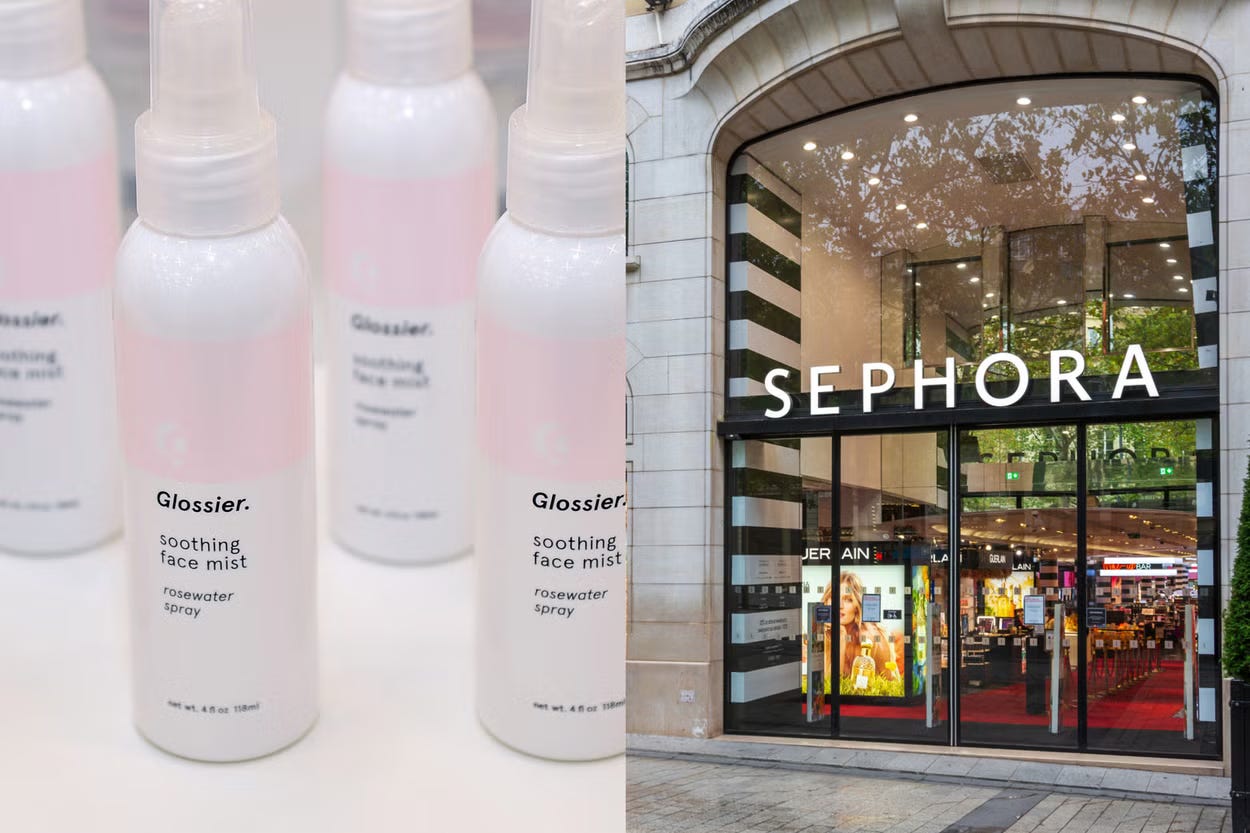
In a Sephora store, there is no pink bubble wrap, and there is no Into the Gloss mythology. There is a shelf talker, a tester, and a shelf stacked with other brands and other products - each with its own set of promises. Your brand story is compressed into approximately two inches, and your product has to white-knuckle its own conversion.
It was at exactly this moment - when Glossier needed its products to work hardest without support - that it changed the formula of its hero product.
The vegan reformulation of Balm Dotcom launched in January 2023, the same month the Sephora deal was announced. It swapped lanolin and beeswax for synthetic alternatives - the 54,000-strong r/Glossier community flooded with complaints. Customers said that the new formula separated, it dried their lips, and it didn’t perform in cold weather.
This is the commercial architecture mistake.
In isolation, the plan to expand via Sephora wasn’t wrong, and neither was the vegan pivot. But what was wrong was making both decisions at the same time. It signalled disconnection across brand, merchandising, and the commercial teams - adding risk at the time the business had one of its most important growth opportunities.
In practice, this meant that the product team reformulated without fully accounting for what the channel team was about to ask of that product. The result was a hero product that couldn’t survive the context it was being placed into, in a retailer where Glossier couldn’t control the end-user experience and explain the product updates.
Brand and commercial had become sequential - neither was accounting for its impact on the other. This created a fracture, and Sephora split it open.
What did the recovery get right - and does it signal a genuine reset?
In May 2024, Glossier restored the original formula. In a campaign masterclass, they also launched a “Comments Section” campaign - turning the Reddit criticism into the announcement itself. They had employees reading negative reviews aloud on Instagram, and the posts announcing the return racked up over 100,000 likes. The community that had been loudest in its frustration became loudest in its celebration.
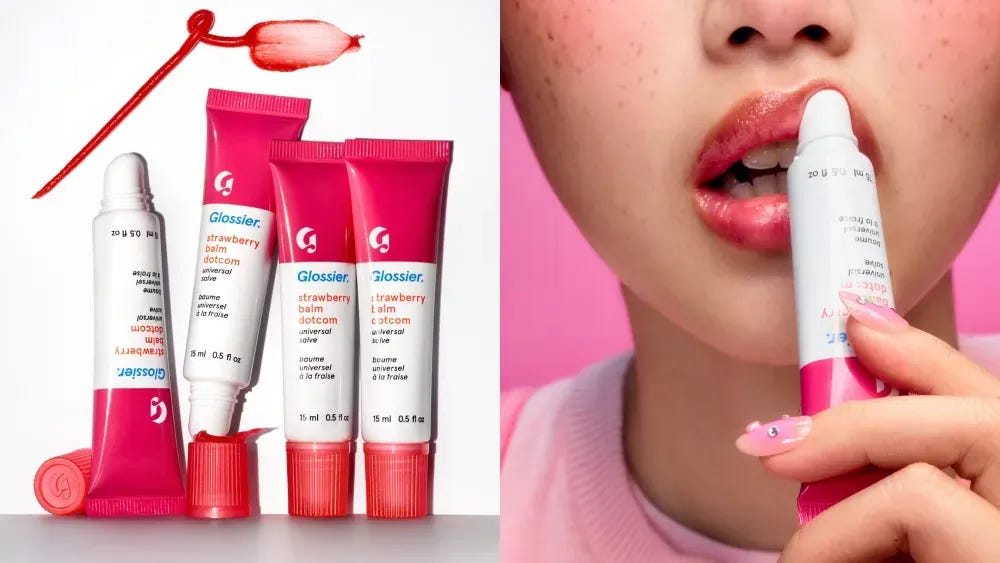
What made this work wasn’t the campaign, it was the sequence. (Although you can't deny that turning your product fail into 'here's the product you told us you couldn't live without' - wasn't genius). Fix the product first, then build the narrative around the fix. That’s integrated thinking - brand and commercial moving together rather than one chasing the other. It reminds me of the saying, “Don’t tell me what you’re going to do - show me.”
Relaunch done, Glossier then welcomed Colin Walsh as CEO in October 2025. Walsh inherited a business that, by early 2025, had been described as profitable and sustainable - which makes his first move more interesting, not less. In February 2026, he cut 54 employees - approximately one third of the workforce. Most trade coverage frames this as a sign of trouble, though I read it differently. Profitable but bloated is a different problem than loss-making, and a business stripping back to move faster is not the same thing as a business in distress. Walsh's first move was not to drive sales via a cash-hungry ad campaign - it was to reduce bloat via a margin-savvy restructure. That's the right order.
What can brand-led businesses take from Glossier’s story?
The one thing brand-led businesses can take from Glossier is the sequencing trap. Sequential thinking - build the brand, choose a channel, then ask the product to perform - creates a gap. And a channel change will find it every time.
Before any non-owned channel decision, the question isn’t which channel to add/use. It’s, “Does this product survive without its story?”
If the answer is yes, the channel will work. If the answer is no, the channel will expose you - and you’ll spend the next two years fixing what you should have fixed before you signed the deal.
Glossier got the channel right and the product wrong at the same moment. The recovery is working because it fixed them in the right order - product first, structure second, narrative last. The next 18 months will confirm whether that discipline holds.
I don’t think that we’ve got to a stage where this is a cautionary tale. I anticipate this becoming part of the fabric of a brand that nearly lost everything - then came back with its very own glow up.
For Glossier, Sephora exposed a gap. But the Balm Dotcom is back! And the community has come back with it.
Now the hard part starts.
Strong Brand Strong Business is part of The Supercharged Mind - published for founders, CMOs, and senior operators in brand-led businesses. Every edition examines a brand building something that lasts - and what the rest of us can learn from how they do it.