Strong Brand Strong Business
Ex duris gloria: Rapha lost focus, experienced pain, and is on the slow road to recovery.
Rapha built a £200 million brand on identity discipline and full-price sell-through. Then it discounted. Eight years of losses and a £102 million write-down later, Fran Millar is running the recovery. The commercial lesson applies to any brand-led business.
At a glance
Rapha last posted a pre-tax profit in January 2017 - the same year RZC Investments acquired the business for £200 million. Every year since has been loss-making.
By late 2019, Mottram publicly admitted full-price sell-through had been in decline before the headline losses confirmed it - a £30.4 million operating loss on revenues of £75.6 million, and a £30 million emergency injection to prevent default on a £20 million bank loan.
In October 2025, Rapha’s holding company wrote the carrying value of the business down by £102 million - from £169 million to £67 million - while CFO Michelle Woolaghan described the revenue contraction as a deliberate choice to come off the “discounting drug.”
Businesses find out they have a brand problem when revenue falls. The unfortunate thing is that they could have avoided it - two metrics prior.
The first metric is full-price sell-through. This is the share of product sold at full price before discounting has to be used to drive revenue. When that number starts falling, margin reduces - that’s the second step.
Finally, when margin has fallen hard enough for long enough, it pulls down revenue. By this point, the window for a (relatively) low-cost intervention has already closed.
Rapha is a clear example of how this sequence unfolds in practice. Working in retail, the “great brand, takes investment, uses discounts to hit revenue targets” story isn’t unusual. What is unusual is the irony - Rapha’s entire founding premise has become a form of commercial karma.
Rapha’s 13 years of identity discipline were recognised with a £200 million valuation.
Rapha was launched in 2004 by Simon Mottram, a road-cycling fanatic who built the brand on a single premise: suffering is what gives cycling its meaning. Ex duris gloria - honour through suffering - was there from the start. Far from being a marketing tagline, it acted as an identity filter.
If you wore Rapha, you were declaring something about how you saw yourself in the sport. Mottram built the entire business - brand and commercial model - around it.
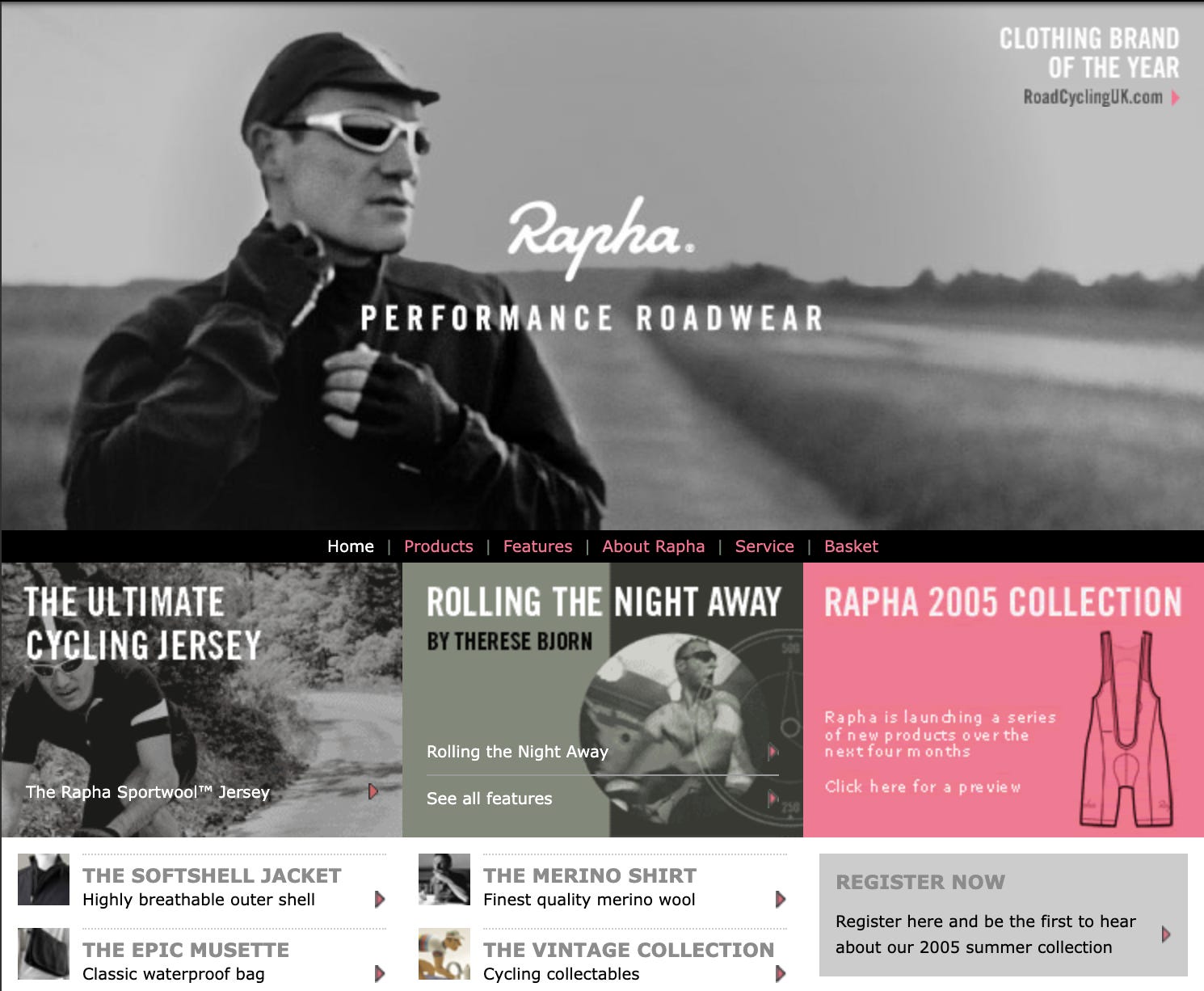
At the time, Rapha’s entire vision - and how it manifested across online and offline experiences - was unusually clean. There was the editorially-led website, a network of Clubhouses from 2012, and the RCC. Everything within Rapha’s system was designed to attract customers who wanted to belong rather than simply buy.
There was full-price discipline, word-of-mouth acquisition, and a customer base that would buy things that didn’t even relate to physical riding - e.g. postcards - because they were Rapha.
In 2017, RZC Investments - the Walton heirs - acquired the business for £200 million, reportedly twenty times annual profits. This was also the last year that Rapha turned a profit.
The four key decisions that diluted Rapha’s brand signal.
Post-acquisition, Rapha made a series of moves to capitalise on the brand’s magnetism. It expanded wholesale into multi-brand retail, extended the product range into mountain biking, opened more Clubhouses, and let seasonal clearance become routine discounting.
In isolation, each one made sense. But together they moved against positioning and exclusivity - the two things that had fuelled the brand’s success.
The impact of the fourth point - discounting - is perhaps the most significant.
Inside the industry, we’d been keeping tabs on Rapha for years. We could see that full-price sell-through was starting to move - even before reported revenue. Previously Rapha’s sale was a “blink and you’ll miss out” affair, but gradually there were more and more lines appearing in its clearance section. It was also getting easier to buy discounted products in core sizes.
By late 2019, Rapha reported an operating loss of £30.4 million on revenues of £75.6 million. There had also been a £30 million emergency injection to prevent default on a £20 million bank loan.
To his credit, Mottram didn’t shy away from the issue:
“There’s a point at which the discounts at the end of the season become mid-season discounts and early-season discounts. And then Black Friday and it ends up being far too much of your business.”
He said they’d taken their eye off the ball. What he was describing was a margin problem that had been running for years, in advance of the revenue damage being visible.
Then came the external tailwind of the pandemic-created cycling boom. For Rapha, it was both a blessing and a curse, masking a broken business.
By way of a blessing, industry-wide demand lifted Rapha’s revenue to a peak of £138 million for the period ending 30th January, 2022.
By way of a curse, when the tailwind ended, the fractures in the underlying structure came into view: revenue fell to £110 million, then £96 million; pre-tax losses almost doubled to £22.7 million; RCC membership dropped from 22,000 to 18,000; and new web customers from 148,000 to 118,000.
All-in-all, Rapha’s spent eight years in the red.
Millar’s turnaround is ex duris gloria applied to the P&L.
Fran Millar became CEO in September 2024. Her appointment was logical - cycling had always been in her life (personally and professionally), and she’d already been credited with turning around Belstaff.
Millar guided Belstaff out of a £20 million loss in 2020. Her approach was to stop chasing volume, and when she left the business it was on track to break even. She’s clear on the similiarities:
The 2024 accounts are the first P&L of the new direction. Revenue fell 13% to £96 million - but far from being further deterioration, it was a controlled contraction. Per CFO Michelle Woolaghan’s comments:
Plus, new web customers lifted from 118,000 to 126,000.
The same results included the £102 million write-down in carrying value. On one hand, it would be easy to see this as further failure. But the write-down was framed, with some candour, as a more honest account of where the business stands today.
The numbers aren't the lesson. The lesson is, in fact, the decisions that were made alongside the 2024 numbers. They echo the identity discipline of the founding model:
annual product launches cut from roughly 65 to around 30,
the lifestyle range discontinued,
five underperforming Clubhouses closing - Boulder, Chicago, Miami, Seattle, Manchester
RCC Partner Cafés,
wholesale rebuilt around brand fit.
Rapha also entered a new market (Shanghai, late 2025) where the original product proposition still has room to run.
Eighteen months in, Millar told Escape Collective that the progress has been slower than anticipated, but that it was par for course. The irony being that this is a brand who’s founding premise is that there is honour through suffering.
Brand deterioration doesn’t arrive overnight - it’s the end of a longer sequence.
The gap between the leading signal and the response might be quantified as the £102 million write-down. At its heart, Rapha’s past eight years aren’t a private equity story or a creative direction story - they’re the outcome when brand and commercial are treated as separate conversations. More pointedly, when the brand conversation is the one that loses to chasing numbers.
For any brand-led business, the practical implication is to keep full-price sell-through front and centre in your reporting. It’s the earliest indicator you have, and by the time the revenue line shows any brand damage, the window for a low-cost intervention has already closed.
Rapha built a brand on the belief that suffering is what gives the hard thing its meaning. Ironically, its financial reports over the past eight years show what happens when a brand chases the easier route to growth. In true Rapha storytelling fashion, the recovery Millar is running - deliberate, hard, slow - is so on-brand it hurts.
If this was worth your time, forward it to someone who'd find it useful. If you’re working through something similar, reach me at suzannah@strongbrandstrongbusiness.com
This content is produced for informational purposes. It does not constitute specific business, commercial, or strategic advice for any individual organisation.